Saturday, January 25, 2020

Around the Blogosphere This Week

Miscellaneous bits of news and fun stuff from around the internet...

...Over the past few days Kino Lorber has announced several titles coming in April, starting with Ernst Lubitsch's ANGEL (1937), starring Marlene Dietrich, Herbert Marshall, and Melvyn Douglas. It will have a commentary track by Joseph McBride, author of HOW DID LUBITSCH DO IT? I reviewed ANGEL after seeing it at UCLA in 2018...Also coming in April: SUPERNATURAL (1933) with Randolph Scott and Carole Lombard.

...Kino Lorber will also be bringing out some of the titles which were released on DVD in the 2005 Gary Cooper Collection: BEAU GESTE (1939), which I reviewed at UCLA in 2015, will have a commentary track with William Wellman Jr. and Frank Thompson; THE LIVES OF A BENGAL LANCER (1935) will have a commentary by Eddy von Mueller; and THE GENERAL DIED AT DAWN (1936) will have a commentary by Lee Gambin and Rutanya Alda.

...Finally, Kino's March releases will include two different versions of INDISCRETION OF AN AMERICAN WIFE (1953), starring Jennifer Jones and Montgomery Clift. Additional March releases from Kino Lorber were listed in my last two roundups.

...Over at 50 Westerns From the 50s, Toby says Kino Lorber will be bringing out a bunch of Universal Westerns on DVD and Blu-ray. This is potentially very exciting news, if the forthcoming films are titles which haven't yet had Region 1 releases. The upcoming Kino release of Universal's WINGS OF THE HAWK (1953) gives me hope we might get more titles which haven't been available in the U.S. We'll see...

...The Disney+ series in which Ewan McGregor will reprise his role as Obi-Wan Kenobi, announced with great fanfare at last summer's D23 Expo, is at least temporarily on hold. The search is on for a new scriptwriter. McGregor and director Deborah Chow are expected to remain with the project after it is retooled.

...New cookbook alert: Coming next week from America's Test Kitchen is EVERYTHING CHOCOLATE: A DECADENT COLLECTION OF MORNING PASTRIES, NOSTALGIC SWEETS, AND SHOWSTOPPING DESSERTS.

...A sequel to last fall's lovely DOWNTON ABBEY (2019) movie is in the works.

...I'm rather baffled by the announcement that the Criterion Collection is handling the Blu-ray releases of Netflix's brand-new Oscar-nominated movies.

...On my wish list: PINE-THOMAS PRODUCTIONS: A HISTORY AND FILMOGRAPHY by David Tucker, published by McFarland last summer.

...Big news at Animation Scoop and Cartoon Brew: The Warner Archive will be bringing out a Blu-ray collection Avery Screwball Classics, Vol. I, on February 18th.

...Attention Southern Californians: A new exhibit is coming to the Bowers Museum in Santa Ana this March: Inside the Walt Disney Archives: 50 Years of Preserving the Magic.

...Notable Passings: John Karlen, whose extensive TV work included the series CAGNEY AND LACEY (1981-88), has died at 86...Jack Kehoe, who played the Erie Kid in THE STING (1973), has passed on at 85.

...For additional links of interest to classic film fans, please check out my January 18th roundup.

Have a great week!

Friday, January 24, 2020

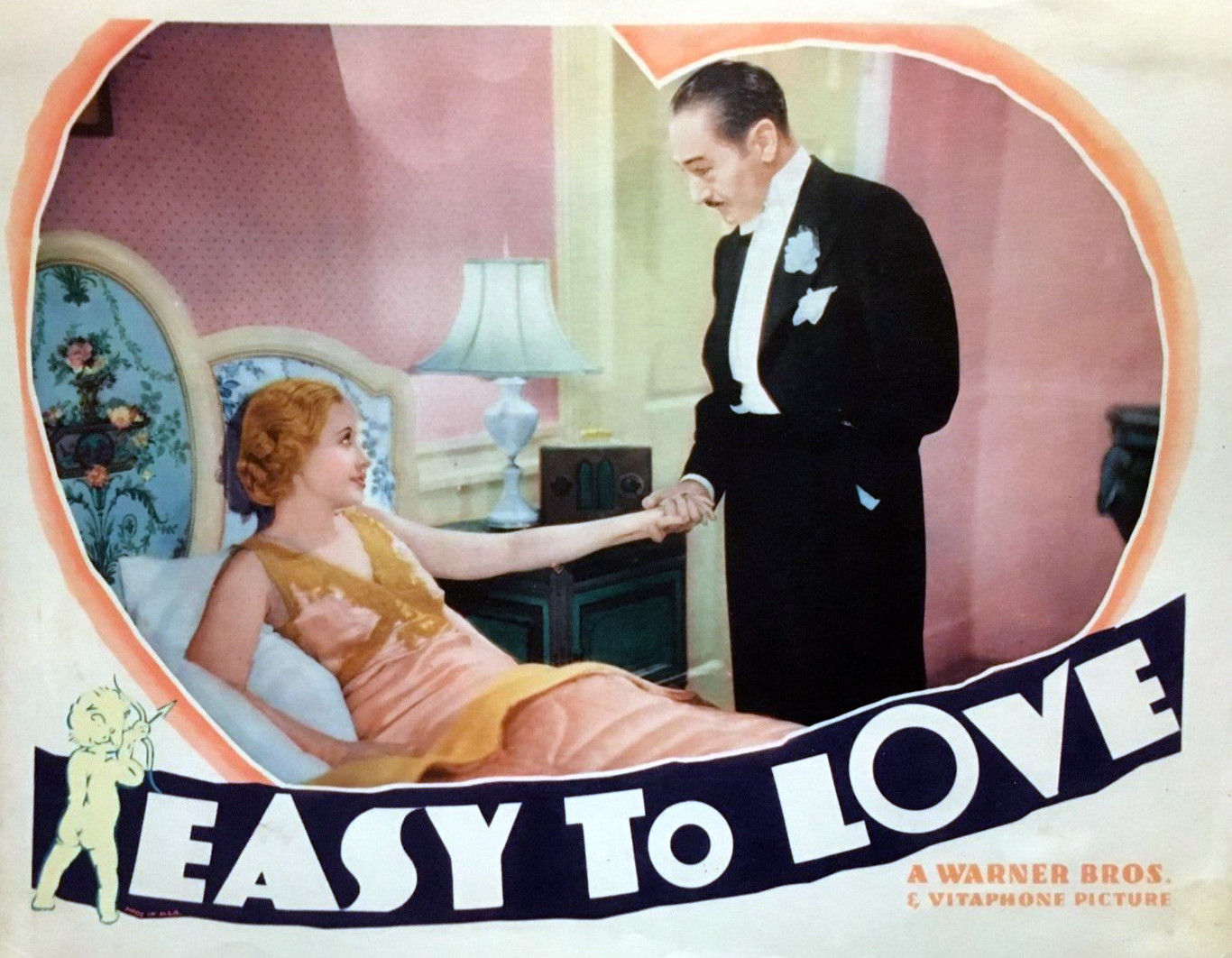
Tonight's Movie: Easy to Love (1934)

EASY TO LOVE (1934) is a delightful pre-Code bedroom farce, with charming Genevieve Tobin heading a terrific cast.

This short 61-minute comedy is in the style of a pair of Tobin's later films, THE GOOSE AND THE GANDER (1934) and SNOWED UNDER (1936). They were all made for Warner Bros. and accomplish something that's just not done in the movie business anymore, spinning a funny romantic yarn in about an hour and then calling it quits.

Tobin plays Carol, who as the movie opens is frustrated by her husband John's (Adolphe Menjou) lack of romantic interest; she laments that her marriage has gone from a double bed to twin beds to separate bedrooms.

Carol visits their doctor (William B. Davidson) for advice, thinking John is tired out from playing too much polo, but when she realizes he's not actually spending his afternoons at the polo grounds she hires a private detective (Frank McHugh). Lo and behold, John is keeping company with Carol's best friend, Charlotte (Mary Astor)!

Carol and John's friend Eric (Edward Everett Horton) has long carried a torch for Carol, and she hatches a plan for the two of them to stop by Charlotte's apartment while John is there. As John hides in a closet, he fumes while listening to Carol carry on about carrying on with Eric.

Of course, a story like this could be a total melodrama, and Tobin does have a couple of poignant moments coping with her husband's infidelity, but it's mostly played for laughs. The movie builds to a very funny conclusion, with all four leads characters present in a hotel room while a justice of the peace (Guy Kibbee) presides over the "ax wedding" of Carol and John's daughter Janet (Patricia Ellis) and her boyfriend (Paul Kaye). (The justice of the peace quips "I've had a lot of shotgun weddings, but this is the first fire ax wedding I've ever officiated at!") As the end credits rolled I had a big smile on my face.

The cast also includes the wonderful Robert Greig as Carol and John's butler and Hobart Cavanaugh as a desk clerk; Grieg's character is sweetly solicitous of his employers, and Cavanaugh has a great line.

EASY TO LOVE was directed by William Keighley, who married Tobin just a few years later. They were married from 1938 until his passing in 1984.

The script was by Carl Erickson and Manuel Seff, based on a play by Erickson and David Boehm. Although there are a fairly limited number of sets, the movie manages to escape the feeling of being a filmed play; perhaps the energetic cast and brisk pacing contribute to the cinematic feel. For those who may wonder, this film has no connection to the 1953 Esther Williams film which has the same title.

The movie was filmed by Ernest Haller. Tobin and Astor's gowns were designed by Orry-Kelly.

EASY TO LOVE is available from the Warner Archive. It's a nice print with good sound.

Thursday, January 23, 2020

Tonight's Movie: Song of Scheherazade (1947)

The music of Rimsky-Korsakov is showcased in Universal Pictures' colorful and engaging SONG OF SCHEHERAZADE (1947).

I'll say at the outset this is a rather crazy movie, but in the best possible way. I think I smiled from start to finish.

It's 1865 and a Russian ship is moored in Morocco during a 116-degree heat wave. Crew member Nikolai Rimsky-Korsakov (Jean-Pierre Aumont) and his friend, the ship's doctor (Charles Kullmann) have shore leave and run from house to house looking for a piano to try out the music Nicky has been writing at sea.

They have the luck to stumble into the home of Madame de Talavera (Eve Arden) and her beautiful daughter Cara (Yvonne DeCarlo). Cara, incidentally, has a secret life dancing as an entertainer at a club, but anyway...

I don't even know where to go from there with a plot description, as it's all a bit nutty, but oh, is it ever fun, with the lush Rimsky-Korsakov music layered over some very amusing comedy. Miklos Rozsa conducted and composed additional music, and Kullmann, a Metropolitan Opera singer, has a glorious voice, while DeCarlo has the chance to do several dances.

Brian Donlevy is hilarious as the ship's captain, who insists his crew be perfectly turned out at all times despite the oppressive heat, though he reviews them while only half-dressed himself. The captain also has a talent for swallowing cigarettes...told you it's crazy! Donlevy plays the role of the seemingly stern captain with the proverbial heart of gold with great good humor. Donlevy biographer Derek Schulthorpe classes Donlevy's performance as "a delight...such fun to see him being so silly, sending up his own image."

SONG OF SCHEHERAZADE is a giddy fantasy which beckons viewers to go along for the ride, never mind the destination. Glorious music, stunning color, funny actors, and one of the most beautiful leading ladies to ever be filmed in Technicolor...I couldn't have asked for more. For me it was 105 delightful minutes.

Good-natured Technicolor escapism which also serves up ample doses of "culture" in the form of classical music was relatively common in the '40s yet simply isn't done anymore; that also makes this film a fascinating relic of its era in that regard.

SONG OF SCHEHERAZADE was written and directed by Walter Reisch. It was filmed by Hal Mohr and William V. Skall.

The supporting cast includes Phillip Reed, Terry Kilburn, John Qualen, Richard Lane, George Dolenz, and Elena Verdugo, who was seen last week in THE MARKSMAN (1953).

SONG OF SCHEHERAZADE is available on DVD in the Universal Vault Collection. I wondered if the color possibly should have been a little brighter at times, but other than that, the print looked terrific.

Wednesday, January 22, 2020

Tonight's Movie: Fingerprints Don't Lie (1951)

FINGERPRINTS DON'T LIE (1951) is a 57-minute programmer available from VCI Entertainment in their Forgotten Noir Collector's Set Series 2.

I've previously enjoyed FBI GIRL (1951) from this collection, as well as films in other Forgotten Noir volumes. They're typically low budget but reliably entertaining, with good casts.

This film was less enjoyable than the typical "Forgotten Noir" film, but it still had its moments, and a couple memorably low-budget aspects almost pushed it into "so bad it's good" territory.

As the movie begins, Paul Moody (Richard Emory) is convicted of the murder of Mayor Palmer (Ferris Taylor) on the basis of fingerprint testimony by police forensic expert James Stover (Richard Travis, THE MAN WHO CAME TO DINNER).

The late mayor's daughter Carolyn (Sheila Ryan), who is also Paul's fiancee, visits Stover to see if there's any way his testimony could have been wrong. Although her father had opposed her marriage to Paul, there were corrupt officials with a far greater motive to murder her father, and she maintains faith in her fiance.

Although the fingerprint at the crime scene was clearly Paul's, Stover is concerned enough to start looking at other explanations for the murder.

The plot is fairly humdrum, but the execution is something else again -- starting with the film being scored with organ music! It reminded me of an old-time radio show -- this one just happened to have pictures to go with it. Other than silent film scoring, which is another thing entirely, I don't think I'd ever seen a film like this scored with an organ, and it was enjoyably bizarre.

Additional signs of a low, low budget abound, including an establishing shot of a building with the street numbers and words on the building backwards. I'm not sure if it was film or a filmed photograph, but whatever it was, the negative was flipped the wrong way!

Another odd moment comes when the real murderer looks out a window straight down to the street a few stories below. He's later shot and falls out the same window, but seems to fall onto a balcony, which had not been visible when he looked out the window. Or did he just happen to fall onto a mattress which wasn't meant to be in view of the camera?

For classic film fans, there's a certain sad irony in Tom Neal playing the prosecuting attorney, given his own very serious run-ins with the law. A few months after this film was released, he infamously beat up Franchot Tone in a romantic dispute over Barbara Payton, sending Tone to the hospital. In 1965 Neal was convicted of involuntary manslaughter in his wife's death; he was paroled after six years but died just a few months later.

Leading lady Sheila Ryan is a happier story. A steadily working actress from 1939, she appeared in everything from Busby Berkeley's THE GANG'S ALL HERE (1943) to the Anthony Mann film noir classic RAILROADED! (1947) to Gene Autry Westerns such as THE COWBOY AND THE INDIANS (1949). The year after this film was released she married Autry's sidekick Pat Buttram, a union which lasted until her passing nearly 23 years later. She was just 54 when she died.

Also in the cast is one-time Miss California Margia Dean, seen last week in RIMFIRE (1949). As was mentioned in the comments to that review, Dean is still with us; she'll be 98 in April.

Lyle Talbot turns up as a police lieutenant, one of many such small roles among that busy actor's scores of credits. The tiresome Sid Melton is ostensibly comic relief as a photographer; my hand itches to hit the fast-forward button whenever he's on screen. Michael Whalen and Rory Mallinson round out the cast.

The movie was directed by Sam Newfield and filmed in black and white by Jack Greenhalgh.

The print and sound quality are quite good, especially considering the film's low budget.

In addition to the previously mentioned collector's set, VCI released this film as part of a double feature disc.

The bottom line is that this "C" level film, while not on a level with other "forgotten" films from VCI, still has aspects which die-hard fans of the "B's" (and lower!) may find enjoyable. I found the cast and the nuttier aspects enough to offset the more mundane, dry scenes, and in the end it was worth an hour of my time. As the saying goes, "Your mileage may vary!"

Tuesday, January 21, 2020

Tonight's Movie: Paris After Dark (1943)

PARIS AFTER DARK (1943) is a well-done film from 20th Century-Fox about the French Resistance, released in the middle of World War II.

George Sanders plays Dr. Andre Marbel, who is secretly leading a Resistance group which posts flyers and other anti-Nazi propaganda throughout Paris. Marbel's nurse Yvonne (Brenda Marshall) is also part of the group.

Yvonne's husband Jean (Philip Dorn), himself a former Resistance fighter, suddenly reappears, released after three years in a German prison camp. Jean is a broken man, physically and emotionally, who believes there is no choice but to cooperate with the Nazis and accept their inevitable victory.

Yvonne realizes she cannot tell her husband about her Resistance work, even though he misinterprets her attendance at a late-night meeting as her having a tryst with Dr. Marbel.

A crisis unfolds when it's learned that hundreds of workers from a nearby factory, including Yvonne's brother Georges (Raymond Roe), are about to be sent to work in Germany. Georges tries to escape to England, where he plans to work for France's freedom, but nothing goes as planned, and both Yvonne and Jean make critical decisions about fighting for France.

The film ends with a rousing call to victory over the radio, in the manner of FOREIGN CORRESPONDENT (1940) or MANILA CALLING (1942). It's interesting to consider what seeing this patriotic film was like for audiences at the time of release in the fall of 1943, when France was still occupied and D-Day months away; it surely must have helped boost U.S. support for the coming invasion of France.

There are a couple creaky bits of dialogue here and there but for the most part it's a well-done film, written by Harold Buchman from a story by Georges Kessel. It was filmed entirely on the Fox lot, but the presence of actual French refugees in the cast, including Madeleine Lebeau and her former husband Marcel Dalio (who were both also in CASABLANCA) lends some authenticity.

Of course, the accents of the cast are all over the place, a mixture of French, Dutch (Dorn), British, and American, but that was par for the course at the time the film was made. The story is strong enough that the viewer is willing to suspend disbelief despite the fact that many of the actors are clearly not French.

I particularly like Sanders and Marshall, so that's an added reason the film worked well for me. I enjoyed watching Sanders in a heroic role as the doctor the Nazis don't suspect is sabotaging them right under their nose.

Marshall will never be classed as a great actress, but she's a beautiful woman and there's something about her I've always enjoyed watching. She does a nice job in this as a woman torn between patriotism and her marriage.

The movie runs 85 minutes. It was directed by Leonide Moguy and filmed in black and white by Lucien Andriot.

I watched PARIS AFTER DARK on a Fox Cinema Archives DVD. While the print quality of some films in this line, especially widescreen and/or Technicolor movies, has been erratic, I've had excellent experiences with black and white films of the late '30s or early '40s; this black and white movie looked great and had a strong soundtrack.

As usual, there are no extras on the Fox Cinema Archives disc.

I especially appreciate that Fox Cinema Archives has made lesser-known World War II films available for home viewing, including the previously mentioned MANILA CALLING, as well as THEY CAME TO BLOW UP AMERICA (1943) and THE MAN I MARRIED (1940); the latter title, released 16 months before Pearl Harbor, remains one of the most interesting little-known films of the war era I've seen to date.

Related review: ACTION IN ARABIA (1944), which also stars George Sanders and was directed by Leonide Moguy.

Monday, January 20, 2020

Tonight's Movie: Linda Ronstadt: The Sound of My Voice (2019) - A Kino Lorber Blu-ray Review

LINDA RONSTADT: THE SOUND OF MY VOICE (2019) is another in a string of interesting documentaries released by Kino Lorber.

Although my musical tastes lean most strongly toward the classic performers of the Great American Songbook (Sinatra, Fitzgerald, et al.), musicals, and '80s country, there were a handful of popular singers of the '60s and '70s I loved -- and still do -- including Karen Carpenter, John Denver, and Linda Ronstadt.

I think my earliest memory of Ronstadt is hearing "Blue Bayou" on the radio in high school. I love all the variations of Ronstadt's music in the years since, from her original melding of rock and country, to mariachi songs, THE PIRATES OF PENZANCE, and her own renditions of music from the Great American Songbook. In the mid '80s my husband and I saw her in concert with Nelson Riddle at the Universal Amphitheatre.

THE SOUND OF MY VOICE is not just a great look at Ronstadt's career and music, it's a real nostalgia trip for a child of Southern California in the '70s, with film and stills of L.A. streets and clubs, as well as things like a glimpse of a page in the L.A. Times; an interview with former Times music critic Robert Hilburn; and footage of Linda on the Johnny Carson and Dick Cavett TV shows. It served as a multimedia visit back to that era, which I really enjoyed.

The overall focus of the documentary is on Linda's family background, the evolution of her career, and her performance of various styles of music. For the most part it steers clear of her politics and personal life, keeping the focus firmly on the music, a decision which I happily endorse; perhaps the documentary doesn't dig as deeply into Ronstadt's life as it could, but the format keeps the focus on her music and in so doing also avoids potentially divisive topics.

That said, the film does briefly address the illness which sadly has stilled her singing voice.

There are extensive music clips, many from old TV shows; there could have been even more songs I love included, but then it might have run twice the 95-minute running time!

The well-edited array of "talking heads" includes Dolly Parton, Emmylou Harris, Bonnie Raitt, Jackson Browne, and many others who worked with Ronstadt over the years.

The documentary was directed by Rob Epstein and Jeffrey Friedman.

Those who enjoy Linda Ronstadt's singing as much as I do are sure to enjoy this musical visit down memory lane.

Extras on the Kino Lorber Blu-ray are additional interviews, the trailer, and a gallery of trailers for other Kino Lorber releases.

This documentary has also been released on DVD.

Previous reviews of documentaries released by Kino Lorber: OBIT: LIFE ON DEADLINE (2016), HAROLD AND LILLIAN: A HOLLYWOOD LOVE STORY (2015), DAWSON CITY: FROZEN TIME (2016), THE GODDESSES OF FOOD (2016), BOMBSHELL: THE HEDY LAMARR STORY (2017), and CHEF FLYNN (2018).

Thanks to Kino Lorber for providing a review copy of this Blu-ray.

Sunday, January 19, 2020

Tonight's Movie: The Good Fairy (1935) - A Kino Lorber Blu-ray Review

THE GOOD FAIRY (1935), a truly magical romantic comedy directed by the great William Wyler, was released on Blu-ray this past week by Kino Lorber.

I first saw this film just about a decade ago, and I remembered very little about it, other than that I liked it. The thing that particularly stayed in my memory was Margaret Sullavan waving a light-up arrow as a movie theater usherette. Both the arrow and the film were just as charming as remembered.

The screenplay was written by another great, Preston Sturges, based on a play by Ferenc Molnar. It concerns a very innocent, somewhat daffy young girl named Luisa (Sullavan) who has just left the Budapest orphanage in which she was raised in order to take a job as an usherette at a theater owned by Mr. Schlapkohl (Alan Hale Sr.).

There are lots of young men (including Cesar Romero!) waiting at the stage door to date the pretty young usherettes, but Luisa is taken under the wing of a protective waiter (Reginald Owen) determined to preserve her innocence. The waiter sneaks Luisa into a fancy ball, where she meets wealthy Konrad (Frank Morgan), who has designs on her virtue.

Luisa promised the orphanage director (Beulah Bondi) that she'd do a good deed every day, and an opportunity opens up for Luisa to help a poor but honest lawyer, Dr. Sporum (Herbert Marshall). It's all very complicated, having to do with Konrad wanting to pay off Luisa's mythical "husband" so she'll be his mistress, or something like that, so Luisa selects Sporum's name out of the phone book to be showered with Konrad's largesse.

From there, matters only get crazier, but it's all quite delightful and fun. A storyline such as that could easily veer into the crass or tasteless, but it's all handled with a lighter-than-air, gossamer touch; in fact, the supposedly lecherous Konrad eventually reveals himself as an insecure man who really just wants to get married and have children.

This type of role was perfect for Sullavan, whose silliness always charms rather than exasperates. The scene where Sporum gifts her with a "genuine Foxine" fake fur and she cries because it's the first gift anyone has given her is both funny and touching.

By the final scene Luisa has three men (Marshall, Morgan, and Owen) wrapped around her little finger, all wanting to help her; I got to thinking Sullavan and her character in that regard reminded me of a Deanna Durbin character, such as in FOR THE LOVE OF MARY (1948) -- and then had to laugh as I suddenly remembered that Durbin actually remade THE GOOD FAIRY, playing Sullavan's role! In fact, that's one of only three Durbin films I've not seen; I love Durbin so much that I've been reluctant to completely finish off her "new-to-me" movies.  There's something tantalizing about knowing I still have a couple of her films yet unseen, but I guess that's a bit silly at this point, so I should catch I'LL BE YOURS soon.

Back to THE GOOD FAIRY, there are so many marvelous bits, from the previously mentioned light-up arrow to the very funny movie playing in the theater to Sporum honking his car horn and rhapsodizing about office equipment. There's also a great little chase scene near movie's end. The good lines come very quickly, so this is a film which demands one's full attention so as not to miss anything.

Marshall is particularly wonderful as the dour, rude professor, who gradually evolves into a completely different, caring personality thanks to Luisa entering his life. When he finally shaves off his horrible beard and reveals "movie star" good looks underneath, it's such a shock that Luisa doesn't initially recognize him.

It's fun to note that half a decade later Sullavan and Morgan would costar in another romantic comedy set in Budapest, THE SHOP AROUND THE CORNER (1940).

THE GOOD FAIRY was filmed by Norbert Brodine. The film's running time is 98 minutes.

The great cast also includes Eric Blore and Luis Alberni. One of the orphanage girls listed at IMDb is said to be Ann Miller; I'll have to look for her next time I watch.

Extras on the Blu-ray are the trailer, a trailer gallery for six additional films available from Kino Lorber, and a commentary track by Simon Abrams.

Thanks to Kino Lorber for providing a review copy of this Blu-ray.

Saturday, January 18, 2020

Tonight's Movie: It Always Rains on Sunday (1947) - A Kino Lorber Blu-ray Review

Crime meets domestic melodrama in the British film IT ALWAYS RAINS ON SUNDAY (1947), recently released on Blu-ray and DVD by Kino Lorber.

In this film set in postwar London, Googie Withers plays Rose Sandigate, who lives in the East End's Bethnal Green. Rose is married to an older man, George (Edward Chapman), and has combative relationships with her young adult stepdaughters Vi (Susan Shaw) and Doris (Patricia Plunkett); there's also a younger son, Alfie (David Lines).

It's a fairly difficult life of deprivation and hard work, with family members finding small pleasures at the local pub, cinema, or arcade. Then one Sunday Rose discovers a prison escapee named Tommy Swann (John McCallum) in the family's bomb shelter. Tommy and Rose had been in love before his imprisonment and her marriage, and she agrees to help by drying his soaked clothes, as well as giving him food and a place to sleep for a few hours while the family are out of the house.

Detective Fothergill (Jack Warner) is on Tommy's track, to no avail. Then just when it's nightfall and Tommy is about to leave, a newspaper reporter shows up at the front door...

This story serves as the film's center, but the film is also a portrait of the family and their greater community, with daughter Vi having an affair with a married music shop owner (Sydney Tafler) and Doris bickering with her boyfriend (Nigel Stock) over a job offer she receives from a disreputable fellow.

Meanwhile a trio of criminals in the area (Jimmy Hanley, John Carol, and Alfie Bass) are trying to unload a hot shipment of...roller skates?!

I had mixed feelings about this film. I enjoy British films and liked the authentic locations and various "slice of life" bits: The movie star photos on the girls' bedroom wall, the family having to bathe in a tub next to the kitchen fireplace, the ration book to buy cheese, the backyard bomb shelter turned into a storage shed, and the music store with its record listening room.

There's also some very nice humor; my favorite character in the entire movie was Sadie (Betty Ann Davies), the music store owner's wife, who advises young Vi about her unfaithful husband's quirks prior to announcing that she's leaving him. The not-very-dangerous robbers trying to fence roller skates were amusing as well.

On the other hand, it's a fairly dark film; almost everyone in the film is either A) depressed, B) up to no good, or C) both! The sad state of almost every character wears on the viewer after a while.

Withers is quite good as a woman living a dead-end existence who has memories of the past reawakened when Tommy appears -- but she's also so nasty it's a little hard to take. Her "wicked stepmother" personality probably results from her unhappiness, not to mention tension over having Tommy hiding in the house, but her endless rudeness to her stepdaughters becomes quite grating.

Just when you think, though, that it's becoming too much of a one-note performance, Withers has a great scene where Rose gives Tommy the ring he'd once given her, to hock for getaway funds; her nonverbal reaction, as she suddenly realizes he doesn't even recognize it, is understated and moving.

A choice Rose makes near movie's end, however subtly depicted, would never have been allowed in 1940s Hollywood; in fact, my understanding is that KISS OF DEATH (1947) had to edit out references to a similar situation that very same year. It's thus interesting contrasting some of the subject matter included in this British film.

It's nice  to note that Withers and McCallum married the year after costarring in this film, a union which lasted 62 years.

IT ALWAYS RAINS ON SUNDAY was directed by Robert Hamer and filmed in black and white by Douglas Slocombe. A trio of screenwriters worked on the film, based on a novel by Arthur La Bern. It runs 92 minutes.

The Kino Lorber Blu-ray includes a commentary by Imogen Sara Smith and two featurettes, including one on the film's locations. The disc also contains the trailer, along with trailers for three additional films available from Kino Lorber.

Given the stronger-than-usual British accents and slang in this film, it's worth also noting that the disc includes subtitles. The Blu-ray print, as is usual for Kino Lorber, looks good.

Thanks to Kino Lorber for providing a review copy of this Blu-ray.

Around the Blogosphere This Week

Miscellaneous bits of news and fun stuff from around the internet...

...This week Turner Classic Movies announced that Leonard Maltin will be the recipient of the third annual Robert Osborne Award at this year's TCM Classic Film Festival. Maltin follows in the footsteps of prior honorees Martin Scorsese and Kevin Brownlow. The award honors "an individual who has helped keep the cultural heritage of classic film alive for future generations." TCM couldn't have chosen a more appropriate recipient than Mr. Maltin, whose books have been part of my life for decades.

...Mr. Maltin will be honored at a nitrate 35mm screening of William Wyler's COUNSELLOR AT LAW (1933) at the festival. I was very fortunate to see that nitrate print at UCLA in 2018. It's a terrific movie and I would certainly enjoy the chance to see it again.

...TCM and Fathom Events are hosting a nationwide digital screening of AN AMERICAN IN PARIS (1951) on January 19th and 22nd. Here's a new interview with Leslie Caron, given in conjunction with the screenings. It's hard to believe it's been close to ten years since I was fortunate to meet her at a screening of the film at the Egyptian Theatre.

...Very interesting news this week: Warner Bros. and Universal announced a joint venture with the goal of keeping the DVD and Blu-ray market viable. With the sales of home discs declining, the two companies will pool resources to handle North American distribution of "new releases, library titles and television shows." Per the Los Angeles Times, "The idea is to combine resources to continue selling discs — while saving money." This is good news for those of us who believe in the importance of owning physical media we control ourselves, rather than relying on the whims of the companies and programmers who run streaming services. The big questions now: 1) Will the "library titles" include the pre-1949 Paramount titles which have been unavailable to consumers for many years, not to mention not-on-DVD Universal films? 2) What, if anything, will this mean for the Warner Archive?

...Kristina of Speakeasy and Ruth of Silver Screenings have announced the 2020 edition of their great O Canada Blogathon. It will take place from March 6th through the 8th.

...Arrow Academy is releasing a movie I really love, BLACK ANGEL (1946) on January 28th. Glenn Erickson (aka Cinesavant) has an early look posted at Trailers From Hell. The disc includes a commentary track by Alan K. Rode of the Film Noir Foundation. (Update: My screener just arrived, so look for a review here in the near future.)

...Kino Lorber also has some interesting releases coming: BLUEBEARD'S EIGHTH WIFE (1938), THE SONG OF SONGS (1933), and THE FLAME OF NEW ORLEANS are all due out on March 31st. BLUEBEARD'S EIGHTH WIFE is an Ernst Lubitsch film starring Claudette Colbert and Gary Cooper, while the latter two films star Marlene Dietrich.

...And speaking of Dietrich -- who has turned up in my viewing with increasing frequency in recent months -- the Criterion Collection will be releasing DESTRY RIDES AGAIN (1939) on Blu-ray April 14th. I don't think I've seen this film, costarring James Stewart, since I was a teenager and look forward to checking it out again.

...Here's Leonard Maltin on additional recent Blu-ray and DVD releases. I'm happy to note that I have several of the titles he recommends.

...There is currently a fundraiser to provide gravestones for the unmarked graves of eight Hollywood pioneers at Hollywood Forever Cemetery. Samantha (aka Classic Film Geek) has information on the careers of those involved in this Twitter thread. My husband and I have made numerous visits to Hollywood Forever and were happy to make a contribution toward honoring these individuals and helping to preserve their -- and Hollywood's -- history. (January 23rd Update: The fundraising goal has been met!)

...I'm missing a great series of IB Tech prints at the Egyptian this weekend, but I'm hoping to see a 35mm screening of NIGHT TRAIN TO MUNICH (1940) there a week from Sunday afternoon. I've never seen that one on a big screen. The showing celebrates the film's 80th anniversary. Margaret Lockwood, Rex Harrison, and Paul Henreid star in this film directed by Carol Reed, with appearances by the Charters (Basil Radford) and Caldicott (Naunton Wayne) characters from Hithcock's THE LADY VANISHES (1938).

...Attention fans of THE MANDALORIAN: iPhone stickers are newly available. "This is the way!"

...For readers who may be interested and unaware of the book's publication last fall, check out MGM STYLE: CEDRIC GIBBONS AND THE ART OF THE GOLDEN AGE OF HOLLYWOOD by Howard Gutner. I've just taken a peek inside so far, but it looks like the book is as gorgeous as one would hope. For more on the book, here's an article which ran in THE HOLLYWOOD REPORTER in October.

...Here's Marc Myers on Hoagy Carmichael music at JazzWax. This made me realize I don't have any of Carmichael's recordings in my collection, which I plan to rectify very soon.

...Notable Passings: Cathy Crawford LaLonde, daughter of Joan Crawford, has passed on at the age of 72. Cathy disputed her sister Christina's negative book about their mother, saying, among other things, that Joan was "very loving."

...For additional links of interest to classic film (and TV!) fans, please check out the January 11th roundup.

Have a great week!

Friday, January 17, 2020

Tonight's Movie: The Gun Runners (1958) - A Kino Lorber Blu-ray Review

THE GUN RUNNERS (1958), the third film version of Ernest Hemingway's novel TO HAVE AND HAVE NOT, was recently released on Blu-ray and DVD by Kino Lorber.

THE GUN RUNNERS followed TO HAVE AND HAVE NOT (1944) and THE BREAKING POINT (1950) in bringing the Hemingway story to the screen. This version was scripted by Daniel Mainwaring (OUT OF THE PAST) and Paul Monash.

The film was directed by Don Siegel, whose name has been showing up in my viewing with regularity over the past year, including directing the previously reviewed Kino Lorber releases of MADIGAN (1968) and CHARLEY VARRICK (1973).

Audie Murphy plays Sam Martin, who operates a charter fishing boat out of Key West. Sam is happily married to Lucy (Patricia Owens, THE LAW AND JAKE WADE), but struggling financially.

After a client stiffs him for a fee, Sam is hard up for cash. Against his better judgement Sam agrees to take Hanagan (Eddie Albert) and his girlfriend Eva (Gita Hall) to battle-torn Cuba, ostensibly for a night on the town; however, Hanagan is not who he seems -- the suitcase he carries for an evening in nightclubs may be a tipoff -- and kills two men on his way off the island.

Matters go from bad to worse when Hanagan buys the note for Sam's boat, forcing Sam to pilot Hanagan and his gun-running pals back to Cuba in order to retain his boat and his livelihood. Matters get really ugly when Carlos (Carlos Romero), a Cuban revolutionary who is buying the guns, discovers some of the cases on Sam's boat are filled with rocks...

I enjoyed THE GUN RUNNERS quite well. I'm an Audie Murphy fan, and I found this film an exciting and well-paced 83 minutes. It's not Hawks and Bogart's TO HAVE AND HAVE NOT, but what is? (I've not yet seen THE BREAKING POINT.) The film stands on its own as a well-done adventure story.

In fact, I find it curious that multiple reviews refer to Murphy as "bland" or lacking "genuine toughness." I just don't read him that way.

Murphy may be quiet -- and he's surely a different style of actor than his predecessors in this story, Humphrey Bogart or John Garfield -- but as I've watched him, mostly in Westerns, I've always seen a fascinating dangerous streak underneath the mild-mannered exterior. Perhaps that perception is informed by knowledge of Murphy's real-life war record, but in his films he proves time and again that he's really not someone who should be messed with.

Honestly, I rather prefer Murphy's understated manner to Garfield's often showy, more emotional style. A brief glance or look from Murphy may contain volumes. He's consistently underrated.

I've also seen references to Murphy and Owens having no chemistry, but again, it appears I was watching a different movie than others who have reviewed the film. I particularly enjoyed the steamy depiction of Sam and Lucy's marriage, with scenes and lines which are surprisingly direct for the late '50s. I also appreciated that there were plenty of these domestic love scenes, which provided a nice counterbalance for the action sequences.

My one real quibble with the film was that I found the ending too ambiguous, although I'm choosing to interpret it in the most positive manner!

The good supporting cast includes Everett Sloane, Richard Jaeckel, Herb Vigran, John Qualen, Paul Birch, Jack Elam, and Peggy Maley.

Although set in Florida and Cuba, the movie was shot off California's Newport Beach and Balboa Island.

The black and white photography by Hal Mohr isn't anything particularly flashy, but it gets the job done, and the Kino Lorber Blu-ray presents a nice, crisp widescreen print. The soundtrack is fine as well.

The Kino Lorber Blu-ray includes the film's trailer and three additional trailers for movies directed by Don Siegel.

Thanks to Kino Lorber for providing a review copy of this Blu-ray.

Quick Preview of TCM in April

This week Turner Classic Movies posted a preview of its April schedule.

The April Star of the Month is Jane Russell.

17 Russell films will be shown spread across Monday evenings in April.

I'm especially delighted with the choice of Russell; if my records are accurate, this will be Russell's first time to be honored as Star of the Month. The lineup includes the TCM premiere of FOXFIRE (1955), also starring Jeff Chandler.

The April Noir Alley titles will be ADDRESS UNKNOWN (1944), BEYOND A REASONABLE DOUBT (1956), WITNESS TO MURDER (1954), and WICKED WOMAN (1953). (Update: WITNESS TO MURDER has been pulled from the schedule in favor of the Special Home Edition of the TCM Classic Film Festival.)

It's also of note that TCM is showing one of my all-time favorite film noir titles, CRY OF THE CITY (1948), starring Victor Mature, Richard Conte, Debra Paget, and Shelley Winters; Conte and Paget are seen here. The film is a TCM premiere.

April themes include maids, inventors, orphans, Scotland, radio, desert islands, angels, amnesia, and films with titles starting with the words YOU CAN'T. There are plenty of sci-fi films, pre-Codes, and MGM musicals on the April schedule, including the usual appearance of EASTER PARADE (1948) on Easter Sunday.

Several Japanese LONE WOLF AND CUB films will air on Sundays on TCM Imports. These films were one of several strong influences on the hit TV series THE MANDALORIAN (2019) on the Disney+ streaming service.

Filmmakers receiving multifilm tributes in April include Peter Bogdanovich, Akira Kurosawa, Joan Fontaine, William Holden, John Wayne, Eve Arden, Gregory La Cava, and Clifton Webb.

The Webb prime time tribute will include the TCM premiere of THE MAN WHO NEVER WAS (1956), costarring Gloria Grahame; I haven't seen that one yet but have heard great things about it from several people.

Patricia Neal is currently the January Star of the Month, with 31 Days of Oscar following in February. The March Star of the Month will be Joe E. Brown.

I'll have a more detailed look on the April schedule posted here around the end of March.

The TCM Classic Film Festival will also be taking place in Hollywood next April, from the 16th through 20th. Stay tuned for complete coverage! (March 12th Update: The festival, like so many other events, has been cancelled due to the COVID-19 epidemic.)

Update: For more on TCM in April 2020, including information on the special "Home Edition" of the TCM Classic Film Festival, please visit TCM in April: Highlights and TCM Star of the Month: Jane Russell.

Newer›  ‹Older