Tuesday, May 10, 2011

Tonight's Movie: Black Angel (1946)

BLACK ANGEL is a very well-done film noir which benefits from interesting casting and creative, energetic staging. It's an absorbing movie which deserves to be better known.

Blackmailer Mavis Marlowe (Constance Dowling) has been strangled, and Kirk Bennett (John Phillips) is quickly convicted of the murder; he had the misfortune to find the body. Bennett's wife Catherine (June Vincent) is adamant that her husband is innocent, but tired Detective Flood (Broderick Crawford) says there's nothing more he can do. Bennett will soon be sent to the electric chair.

Cathy teams with Mavis's alcoholic husband, Martin Blair (Dan Duryea), in an attempt to find the real killer. Marty and Cathy get a job as pianist and singer in a nightclub owned by Marko (Peter Lorre), their chief suspect. The plot twists and turns until reaching a conclusion that is somewhat unexpected...unless the viewer has recently watched HANGOVER SQUARE (1945). But that's all I'll say on the subject!

The overarching theme of BLACK ANGEL is the tragedy of an alcoholic (the charismatic Duryea) who briefly glimpses the possibility of love and a normal life with a good, loyal woman (Vincent), then realizes it cannot be. However, the film is so fast-paced and interesting that it prevents the film from becoming bogged down in pathos. Duryea is excellent in a role that could be quite annoying; his growing longing for Cathy is palpable and quite romantic.

Leading lady June Vincent is one of the keys to the film succeeding as it does. I'd previously seen her in Deanna Durbin's CAN'T HELP SINGING (1944), though I can't say I remember her offhand; otherwise I don't believe I'd seen any of her films. Vincent is a believable and appealing fresh screen face as the young wife determined to prove her husband's innocence. IMDb asserts that Vincent's singing was dubbed, while at least one other source credits Vincent with doing her own singing; regardless, she puts over the numbers effectively.

Another major plus for the film is the superb cinematography by Paul Ivano. The staging of the opening sequence by Ivano and director Roy William Neill is classic, beginning with the shots establishing the action on Wilshire Boulevard in Los Angeles, with the camera taking note of Duryea standing on the street, then tracking up into Mavis's apartment. It's a beauty.

This was the last film directed by Neill, a veteran of Basil Rathbone's SHERLOCK Holmes series; he died in England, at the age of 59, the same year BLACK ANGEL was released.

BLACK ANGEL was based on a novel by Cornell Woolrich, whose work also inspired minor noir classics such as PHANTOM LADY (1944), DEADLINE AT DAWN (1946), and NIGHT HAS A THOUSAND EYES (1948), as well as Hitchcock's REAR WINDOW (1954).

There are some reoccurring themes in Woolrich's stories, such as the trusting woman determined to prove a man didn't commit a murder; besides BLACK ANGEL'S Cathy, there's the devoted secretary (Ella Raines) fighting for her boss's life in PHANTOM LADY and the dance hall girl (Susan Hayward) trying to protect an innocent young sailor in DEADLINE AT DAWN. The evil that men do in the dark of night is another theme repeated throughout the Woolrich-based films.

The supporting cast includes Wallace Ford, Hobart Cavanaugh, and Freddie Steele. Mary Field appears as -- what else? -- a maid. She most recently popped up as a maid in my viewing in THE CRYSTAL BALL (1943), seen last month. Field had over 180 screen credits, the vast majority in movies.

The set design and decoration are also noteworthy, including Cathy's sunny, neatly kept little house and the sleek nightclub, Rio's. I especially appreciated the large windows in Marko's nightclub office.

BLACK ANGEL has been released on VHS and DVD; the DVD is part of the Universal Noir Collection. (January 2020 Update: BLACK ANGEL will be released on Blu-ray this month by Arrow Academy. My February 2020 review of the Arrow Blu-ray is here.)

April 2012 Update: I had another great experience viewing this film as part of a Cornell Woolrich trilogy at the Noir City Film Festival.

May 2017 Update: BLACK ANGEL continues to be a favorite, as I enjoyed it once more at the Arthur Lyons Film Noir Festival in Palm Springs.

Monday, July 04, 2022

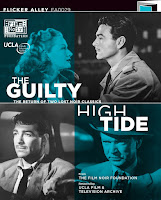
Tonight's Movies: High Tide (1947) and The Guilty (1947) - A Flicker Alley Blu-ray Review

One of the releases I've most looked forward to this year is the new Flicker Alley set containing a pair of Monogram films from 1947, HIGH TIDE (1947) and THE GUILTY (1947).

I first saw these films at the 2013 and 2015 UCLA Festival of Preservation, respectively. Although I was able to revisit THE GUILTY at this spring's Arthur Lyons Film Noir Festival, this was my first time to see HIGH TIDE since I last saw it close to a decade ago.

Both films in the set were produced by Jack Wrather and star his close friend Don Castle; THE GUILTY also stars Bonita Granville, who married Wrather the month before that film's release. It was a happy, successful union which lasted until Wrather's death in 1984. Granville would live until 1988.

HIGH TIDE is a very enjoyable 72 minutes which begins with a memorable opening: Two men, Hugh Fresney (Lee Tracy) and Tim Slade (Castle), have been in a car wreck at the beach and are unable to move, with the incoming tide threatening to eventually drown them.

In flashback, we then see how the men came to be in that position. It's a tale of multiple murders, crime, and other skullduggery told against the backdrop of the newspaper business.

Julie Bishop plays the unfaithful wife of the paper's owner (Douglas Walton), Anabel Shaw plays the publisher's sweet young secretary, Francis Ford is an informant, and the always-great Regis Toomey plays a detective unraveling a series of murders. Toomey also plays the detective solving the murder in THE GUILTY.

THE GUILTY is equally fast-paced, running just 71 minutes. It's a haunting story about roommates, Mike and Johnny (Castle and Wally Cassell), mixed up with identical twin sisters, good Linda (Granville) and no-good Estelle (also Granville). Linda is strangled, and suspects include Johnny, a veteran who suffers from what we would now term PTSD, and Alex (John Litel), who boards in the sisters' family's apartment.

Both films, while not "classics," are solidly entertaining and have notable strong points, with particularly good work by Regis Toomey in each film. Viewers won't soon forget his description of how the murder was committed in THE GUILTY; it's strong stuff.

Veteran Lee Tracy gives HIGH TIDE much of its punch, while a double dose of Granville makes THE GUILTY special.

The screenwriter of both films was Robert Presnell Sr., who incidentally was the father-in-law of beloved actress Marsha Hunt. HIGH TIDE was based on a Raoul Whitfield story, "Inside Job," while THE GUILTY was based on "He Looked Like Murder" by the great Cornell Woolrich.

Both films were directed by John Reinhardt and filmed in black and white by Henry Sharp. I particularly enjoyed the location filming at L.A.'s Union Station seen in HIGH TIDE.

The restored prints of each film are excellent, including fine soundtracks.

The very substantive extras begin with a short joint introduction to the films by the Film Noir Foundation's Eddie Muller. Jake Hinkson provides a commentary track on THE GUILTY, with the Film Noir Foundation's Alan K. Rode doing the honors for HIGH TIDE.

There's an informative featurette on producer Jack Wrather which includes interviews with Wrather's son Chris, Don Castle's daughter Gretchen, and Alan K. Rode. The documentary explores Wrather's many contributions to pop culture history, including producing Lassie and opening the Disneyland Hotel, along with fond reminisces by those who knew and respected him. It's nice to hear such a positive personal story -- all the more in the context of film noir.

Two more excellent pieces are "Nightmare: The Life and Films of Cornell Woolrich" and "John Reinhardt: Direction Without Borders." Woolrich's sad, isolated life is a notable contrast from Wrather's "It's a Wonderful Life" story.

My very favorite piece in the set was a 20-minute "verbal essay" by Imogen Sara Smith on Lee Tracy and his creation of the "newspaperman" character in movies dating from early pre-Codes. I have a soft spot for Tracy and have sometimes wondered why, as his characters can be abrasive; Smith well describes the force of his personality and that the viewer wishes they could always be ready with a comeback or a quip like Tracy's characters. Smith never fails to impress with her highly articulate insights.

All of the extras combine to inform not just on this pair of films, but on film noir and movie history.

There's also a beautifully illustrated booklet by Brian Light. Half the booklet is on HIGH TIDE, then the reader flips it over for the half on THE GUILTY. Like everything else about this set, it's attractive and thoughtfully produced. The set is capped off with reversible cover art.

Along with the beautiful prints of rarely seen films, the set's attractive production design and outstanding extras make this release one of my top recommendations of the year. I class it as a "must buy."

Thanks to Flicker Alley for providing a review copy of this Blu-ray/DVD set.

The two-film set containing HIGH TIDE and THE GUILTY may be purchased through the Flicker Alley website as well as through retailers such as Amazon.

Sunday, April 22, 2012

Tonight's Movie: The Window (1949) at the Noir City Film Festival

Today was a terrific day of programming at the Noir City Film Festival: a triple bill of films based on stories by Cornell Woolrich. With short running times of 73, 81, and 87 minutes, seeing all three films was very doable...and in fact, as I explained in my review of SUDDENLY (1954), film fest viewers were unexpectedly treated to a quadruple bill!

First up was PHANTOM LADY (1944), which I first saw in 2009. I really enjoy Ella Raines, the film's leading lady. The movie has some great set pieces; I especially love Raines stalking a lying bartender. It was interesting that some of Franchot Tone's facial grimaces and reactions played more humorously, seen with a crowd, than when I'd watched it previously at home. The 35mm print had a somewhat dark "smudged" look, but on the whole was acceptable.

The second film on the schedule was BLACK ANGEL (1946), which I first saw about a year ago. It was a treat to see it in an especially gorgeous 35mm print. There are so many things I love about this film, including the performances by Dan Duryea and June Vincent, the music, and the stylish telling of a story with an unexpected resolution. Very highly recommended.

The final film in the Woolrich trio was new to me: THE WINDOW, a real nail-biter of a movie which seemed like a childhood nightmare come to life.

Tommy Woodry (Bobby Driscoll) and his parents (Barbara Hale and Arthur Kennedy) live in a dilapidated tenement building in New York. Tommy is sleeping on the fire escape on a hot summer night when he looks through a window and witnesses his neighbors (Ruth Roman and Paul Stewart) commit a murder. Since Tommy has a reputation for telling tall tales, his exasperated parents don't believe him, nor do the police. But the murderous neighbors learn what Tommy saw, and one night he's left at home alone...

THE WINDOW very effectively mixes a realistic, gritty setting with the stuff of nightmares. (There's a scene where Ruth Roman is peering into the little boy's bedroom window with a flashlight that will unnerve anyone who ever had a childhood bad dream about something scary being outside the window.) The movie was shot on location in New York, and the shabbiness of Tommy's apartment and neighborhood makes his experiences all the more believable; this is no glossy "Hollywood" film, but a very real, rather unpleasant world.

The performances are uniformly excellent, with Bobby Driscoll awarded a special juvenile Oscar for his work. I especially appreciated the performances of Arthur Kennedy and Barbara Hale as Tommy's worn down but loving parents, who are scraping by with the father working the night shift, while also doing their best to manage a somewhat difficult little boy. Paul Stewart and Ruth Roman are appropriately disturbing as the creepy neighbors.

THE WINDOW was directed by Ted Tetzlaff, from a screenplay by Mel Dinelli. The black and white cinematography was by Robert De Grasse and William Steiner.

In his introduction, the Film Noir Foundation's Eddie Muller added the interesting tidbit that while the film is set during the sweltering summer months, the movie was actually filmed in very cold temperatures.

There's a little more information on films based on Cornell Woolrich stories in my review of NO MAN OF HER OWN (1950).

THE WINDOW is available in a remastered DVD-R from the Warner Archive.

Highly recommended. And watch it with the curtains shut tight!

Sunday, July 14, 2024

Tonight's Movies: Never Open That Door (1952) and If I Should Die Before I Wake (1952) - A Flicker Alley Blu-ray Review

One of the highlights of this year's Noir City Film Festival was the opening night film, NEVER OPEN THAT DOOR (1952).

The movie, known in its native Argentina as NO ABRAS NUNCA ESA PUERTA, was shown on a double bill with THE WINDOW (1949).

NEVER OPEN THAT DOOR was just released for home viewing in a dual-format Blu-ray/DVD edition by Flicker Alley. The disc also includes a rare archival scan of the related movie IF I SHOULD DIE BEFORE I WAKE (1952), also known as SI MUERO ANTES DE DESPERTAR; the Film Noir Foundation print of that film is believed to be the last one in existence.

NEVER OPEN THAT DOOR consists of two separate stories told over the course of 85 minutes; the 73-minute IF I SHOULD DIE BEFORE I WAKE was originally intended to be included as a third story in NEVER OPEN THAT DOOR but was released separately.

In this regard the two Argentinian films reminded me a bit of the Julien Duvivier movies FLESH AND FANTASY (1943) and DESTINY (1944), which I saw at the Noir City Festival in 2016.

FLESH AND FANTASY consisted of three separate stories; a fourth story, DESTINY, was filmed for FLESH AND FANTASY but was released separately. Curiously, DESTINY was about a blind girl (Gloria Jean) living in a remote rural area, and the same theme runs through the second story featured in NEVER OPEN THAT DOOR.

All three of the stories featured in NEVER OPEN THAT DOOR and IF I SHOULD DIE BEFORE I WAKE were written by Alejandro Casona based on Cornell Woolrich stories, published under the pen name William Irish. Woolrich's writing, as many of my readers are aware, was the inspiration for a great many American film noir and crime films, including the previously mentioned THE WINDOW.

NEVER OPEN THAT DOOR melds crime with a fantastical tone somewhat reminiscent of the later U.S. TV series THE TWILIGHT ZONE. The tone also reminded me a bit of the Argentinian film THE BITTER STEMS (1956) which was released by Flicker Alley a few years ago.

In the first story, "Somebody on the Phone," a young woman Luisa (Renee Dumas) agonizes over gambling debts. She's followed around town by Raul (Angel Magana), who we at first assume to be her husband, but he turns out to be her caring brother. Before Raul can help Luisa, she dies, and Raul embarks on a course of vengeance with a very unexpected ending.

The second story, "Hummingbird Comes Home," is the tale of a blind woman, Rosa (Ilde Pirovano), who lives with her niece (Norma Gimenez). When Rosa's long-absent son (Roberto Escalado) returns home, Rosa comes to realize he is a robber and murderer. What to do...

IF I SHOULD DIE BEFORE I WAKE is strongly reminiscent of the thriller M, filmed in 1931 and 1951, which was about a man who abducted and killed little girls. In IF I SHOULD DIE BEFORE I WAKE a young boy, Lucio (Nestor Zavarce), whose father (Floren Delbene) is a police inspector, promises a little girl he won't tell her secret about a man who gives her lollipops and promises to take her to his candy house.

The little girl ends up dead, and when a second girl disappears, Lucio must find a way to save her while also keeping his promise to his dead friend.

Needless to say, it's a very dark film, but it's well told and the short 73-minute running time makes it a bit easier to handle.

Both films are beautifully acted, staged, and shot; they remain in the viewer's memory long after they've ended.

The Blu-ray print of NEVER OPEN THAT DOOR is quite beautiful.
While the print of IF I SHOULD DIE BEFORE I WAKE is not of the same caliber, I thought it was very good, especially considering the rarity; the negative the Film Noir Foundation used to make its conservation print has since decayed to the point it is no longer usable, so we're lucky to have it at all.

NEVER OPEN THAT DOOR and IF I SHOULD DIE BEFORE I WAKE were both directed by Carlos Hugo Christensen and filmed by Pablo Tabernero.

The Flicker Alley set also includes a very good documentary, CORNELL WOOLRICH: FEAR HAS NO BORDERS (2024), which runs 26 minutes and was produced by Steven C. Smith and Alan K. Rode. The documentary includes some footage from the Noir City screening I referenced at the start of this review, including portions of Eddie Muller's introduction.

Additional disc extras include a commentary track for NEVER OPEN THAT DOOR by Guido Segal and a 16-minute featurette with Fernando Martin Pena reflecting on Argentine cinema. A beautifully produced 20-page souvenir booklet with glossy photographs is included in the case.

As usual for these Flicker Alley sets, the two discs were produced in attractive contrasting colors. The case includes reversible cover art.

This set is highly recommended.

Saturday, July 20, 2024

Tonight's Movie: Nightmare (1956) - A Kino Lorber Blu-ray Review

Tonight I wrapped up watching Kino Lorber's Dark Side of Cinema XVII collection with NIGHTMARE (1956).

NIGHTMARE, like the set's other films VICE SQUAD (1953) and BLACK TUESDAY (1954), stars Edward G. Robinson. And like those films, I found it interesting and enjoyable.

To be sure, NIGHTMARE has flaws, starting with a sometimes-draggy script by director-screenwriter Maxwell Shane, but it also has several "plus" factors, including the great Mr. Robinson himself. Overall, I enjoyed the movie despite its problems.

NIGHTMARE is a remake of FEAR IN THE NIGHT (1946), which was also written and directed by Shane. In each case the script was based on a story by the prolific Cornell Woolrich.

Just last weekend, as it happens, I saw two other films based on Woolrich stories, the Argentinian movies NEVER OPEN THAT DOOR (1952) and IF I SHOULD DIE BEFORE I WAKE (1952). This year I've seen at least two other films inspired by Woolrich's writing.  He had incredible influence on the film noir and crime film genres.

NIGHTMARE has one of the wilder Woolrich stories I've seen filmed -- probably even crazier than one of my favorite Woolrich tales, NIGHT HAS A THOUSAND EYES (1948), which also starred Robinson.

New Orleans musician Stan Grayson (Kevin McCarthy) wakes up from a terrible nightmare in which he killed someone. As Stan calms down, he's taken aback when he notices things like blood on his hand and a mark on his neck which hadn't been present before he went to bed.  

Stan can't shake the feeling that his dream was real...especially when a key he'd only seen in his dream appears in his room.

The disturbed Stan confides in his brother-in-law Rene (Robinson), a police detective, but Rene brushes off Stan's fears as overwork or stress. Rene warns Stan not to upset his pregnant wife Sue (Virginia Christine), Stan's sister, with his wild story.

As Stan struggles on the verge of an emotional breakdown, circumstances lead to Rene and Stan learning about a murder outside New Orleans which seems to have details which match Stan's nightmare. Rene is initially upset and believes his brother-in-law may be a murderer, but as more facts reveal themselves, Rene realizes something quite different may have happened...

Shane's script is a somewhat draggy 89 minutes; not that Stan doesn't have the right to be worried, but his whining and sullen behavior aren't fun to watch, and the script gets a bit repetitive as Stan tries to convince his disbelieving brother-in-law something sinister has happened.

The film takes off and becomes more engrossing about midway through, when the true story begins to reveal itself and Rene goes into detective mode, offering Stan support and hope instead of snapping at him.

Despite the imperfect script, NIGHTMARE has a number of plus factors going for it, starting with location work in New Orleans. The film seems to use a mix of back projections and actual shooting in Louisiana; I hope to learn more on that topic from the commentary track by Jason A. Ney.

The movie also has some very good jazz music and singing, with trumpet player-conductor-arranger Billy May playing Stan's boss as well as performing with singer Connie Russell, who plays Stan's girlfriend Gina.  The music gives the film a different vibe from the norm, and I enjoyed that aspect.

As a fan of Virginia Christine I also enjoyed her in a nice role as Rene's wife. The subplot with her expecting a baby after several years of marriage -- and being very hungry as a result -- is sweet.

NIGHTMARE was filmed in black and white by Joseph F. Biroc. There's nothing particularly noteworthy about the film's look, but it's a nice, crisp print. The Blu-ray is from an HD master from a 2K scan of the 35mm fine grain.

In addition to the previously mentioned commentary track, there's a gallery of three trailers for other films available from Kino Lorber.

While none of the films is this collection are perfect, I found each of them interesting and enjoyable, and I recommend this set. Fans of Edward G. Robinson will find it especially rewarding having the chance to watch some of his lesser-known but worthwhile films of the '50s.

Thanks to Kino Lorber for providing a review copy of this Blu-ray collection.

Monday, May 23, 2011

Tonight's Movie: No Man of Her Own (1950)

Cornell Woolrich is a name which keeps popping up in my viewing. His novels inspired BLACK ANGEL (1946) and NIGHT HAS A THOUSAND EYES (1948), both of which I've seen in the last few weeks. His books also were the basis for PHANTOM LADY (1944) and DEADLINE AT DAWN (1946), seen in 2009. Tonight's movie, NO MAN OF HER OWN, was based on another Woolrich book, I MARRIED A DEAD MAN, written under his pseudonym, William Irish.

Sally Benson (who wrote SHADOW OF A DOUBT) and Catherine Turney (CRY WOLF) adapted Woolrich's novel, along with uncredited work by the director Mitchell Leisen. The result is NO MAN OF HER OWN, a film noir with a superb lead performance by Barbara Stanwyck as an unwed mother who finds the love of a man and a family, only to be threatened with losing it all.

Pregnant Helen Ferguson (Stanwyck), who's been abandoned by her sleazy boyfriend (Lyle Bettger), meets a lovely couple, Hugh and Patrice Harkness (Richard Denning and Phyllis Thaxter), on a train trip. Patrice, who has never met Hugh's family, is also pregnant.

A terrible train crash kills the Harknesses, but doctors believe that Helen is Patrice. And as "Patrice" and her newborn son are enveloped by the love of the extended Harkness family, she finds herself unable to tell them the truth, all the more so because the Harknesses offer her baby boy security. All is well, and then the sleazy ex-boyfriend shows up with blackmail in mind...

John Lund plays Hugh's brother William, who gradually finds himself falling for "Patrice." The wonderful actors Henry O'Neill and Jane Cowl (ONCE MORE, MY DARLING) play Hugh and William's parents. Venerable character actress Esther Dale plays their loyal housekeeper.

NO MAN OF HER OWN is an excellent film with great atmosphere, blending dark, ominous scenes with sequences exuding warmth and love; the darkness threatens to wipe the good out of Patrice's life, and she's desperate not to hurt her new family.

Stanwyck is at her very best in this, and the rest of the cast is also excellent, down to the smallest parts. (Watch for Griff Barnett as the doctor, Milburn Stone as a police detective, and Dooley Wilson as a train porter.) The film may not be completely believable -- particularly one of the twists near the end -- but the viewer willingly suspends disbelief to enjoy a powerfully acted film.

Director Leisen and John Lund teamed multiple times, including TO EACH HIS OWN (1946), BRIDE OF VENGEANCE (1949), THE MATING SEASON (1951), and DARLING, HOW COULD YOU! (1951). (Lund was also in another Woolrich-based film, NIGHT HAS A THOUSAND EYES, directed by John Farrow.) Lund is one of those actors, along the lines of George Brent or Lee Bowman, who doesn't get a lot of respect, but I've seen several of his films and I always enjoy him. I think NO MAN OF HER OWN is one of his best performances, subtly communicating his questions and his feelings for Patrice without much dialogue. He makes a marvelous romantic hero, and I don't think anyone could have played this role better.

My only quibble with the film was that the blackmailing ex-boyfriend had so much screen time in the last third of the film. It was very unpleasant watching him and what he put the characters through, although his actions also go a long way to explaining why other characters act as they do.

This is the second movie I've watched in recent days in which a woman under duress takes over another woman's identity; the other film, THE HOUSE ON TELEGRAPH HILL, was released a year after NO MAN OF HER OWN. In both cases, the heroine is portrayed very sympathetically, despite her lies, and the hero is not too concerned about who she really is.

The story might have inspired the much later WHILE YOU WERE SLEEPING (1995), a lighter spin on a similar story, minus the blackmail. In fact, the year after WHILE YOU WERE SLEEPING, NO MAN OF HER OWN was remade as MRS. WINTERBOURNE (1996), that time crediting Woolrich's novel as the source.

This film runs 98 minutes. The cinematographer was Daniel L. Fapp. Costume design was by Edith Head.

This movie has no relationship to the 1932 film of the same name starring Clark Gable and Carole Lombard.

NO MAN OF HER OWN is a Paramount film which isn't available on DVD or VHS. I saw it via Netflix streaming; the print streamed by Netflix was in very good shape. Hopefully this film will eventually be released on DVD, as it deserves to be seen by a wider audience.

January 2012 Update: NO MAN OF HER OWN will be released on DVD by Olive Films on March 27, 2012.

December 2012 Update: A few more thoughts on this film after seeing it in 35mm at UCLA.

May 2024 Update: This movie will be released on Blu-ray by Kino Lorber in June 2024.

Update: My review of the Kino Lorber Blu-ray may be read here.

Saturday, February 28, 2009

Tonight's Movie: Phantom Lady (1944)

Unhappily married Scott Henderson (Alan Curtis) is arrested for the murder of his wife. Scott's devoted secretary Carol (Ella Raines) is determined to clear her boss, but in order to do so she must find his mysterious alibi, the PHANTOM LADY. Unfortunately, strange things keep happening to anyone who might have seen the title character.

Resourceful Carol is aided by a police inspector (Thomas Gomez) who has doubts about Scott's guilt. She is also aided by Scott's best friend Jack (top-billed Franchot Tone), but from the time Jack enters the story, 50 minutes into the movie, the viewer knows that Jack is not exactly who he seems.

PHANTOM LADY is a relatively little-known but absolutely wonderful film noir which is filled with rainy streets, shadows on walls, and a gallery of creepy, disreputable characters. The film is very visually striking, including some terrific sets, and is a must-see for fans of the genre.

There are several notable things about the film, such as the unique way a murder trial is depicted, using simply voices, closeups of a court reporter's shorthand notes, and reaction shots of Carol's face. Another sequence in which Elisha Cook Jr. plays the drums, is, er, strangely suggestive. (Leonard Maltin rumors in his 3-1/2 star review that it was dubbed by Buddy Rich.) It's amazing what can be conveyed without showing an inch of skin. The film runs a taut 87 minutes.

I very much enjoyed Ella Raines in this role. I hadn't seen her in a film in a long time and I wish she'd made more of them. Her best-known films include CRY "HAVOC" (which I recently recorded), HAIL THE CONQUERING HERO, TALL IN THE SADDLE, and THE SENATOR WAS INDISCREET. Raines looks a bit like Gene Tierney at times -- when she gussies herself up as a tart she also sounds a bit like Tierney did early in RINGS ON HER FINGERS -- but she has her own unique style. I enjoyed her depiction of a beautiful, feisty woman who wouldn't give up. (I do think she should have been a little smarter in the final sequence, but no plot spoilers there...)

Carrie at Classic Montgomery mentioned that yesterday was the anniversary of Franchot Tone's birth, so it seems apropos to have watched one of his movies this weekend. Tone spent much of his career as a genial leading man or friend of the hero, receiving a Best Actor Oscar nomination for one such role (MUTINY ON THE BOUNTY), and his part as the unbalanced Scott is quite different from the many other films in which I've seen him. I used to think of Tone as rather bland, but have developed a great appreciation for his work over the last couple years and look forward to seeing more of his films.

Alan Curtis -- previously seen in the mid-'30s comedies SMARTEST GIRL IN TOWN and WALKING ON AIR -- is fine as the hapless murder suspect. The supporting cast includes Regis Toomey (a rather uncharacteristic role as a seemingly vacant-headed, gum-chewing police detective), Aurora Miranda (sister of Carmen), Fay Helm, Doris Lloyd, Virginia Brissac, and Victoria Horne.

PHANTOM LADY was directed by Robert Siodmak, who made a number of interesting thrillers, including CHRISTMAS HOLIDAY (1944), THE SPIRAL STAIRCASE (1945), THE KILLERS (1946), CRY OF THE CITY (1948), and CRISS CROSS (1949).

You can read more about PHANTOM LADY in this entry posted by Steve-O at Noir of the Week.

The movie is based on a story by Cornell Woolrich (REAR WINDOW).

PHANTOM LADY does not yet appear to have had a Region 1 DVD release, but it was released in a beautiful VHS print.

September 2009 Update: Thanks to Tim Coleman for writing and sharing the info he recently learned that it was his dad, Dave Coleman, who dubbed the drum solo.

April 2012 Update: I had another great experience seeing this film as part of a Cornell Woolrich trilogy at the Noir City Film Festival.

December 2012 Update: PHANTOM LADY is now available on DVD from the TCM Vault Collection.

Friday, June 07, 2013

TCM Friday Night Spotlight: Noir Writers With Eddie Muller

TCM's Friday Night Spotlight series heads into its third month tonight, with Eddie Muller of the Film Noir Foundation serving as the guest host for June.

As regular readers know, Eddie Muller hosts the annual Noir City Festival and also serves as a host for select screenings at the TCM Classic Film Festival.

Eddie's enthusiasm for all things noir is contagious, and his intros at film festivals are such fun that one can't help becoming interested in the films he describes. My appreciation of the genre has deepened immeasurably thanks to Eddie and his righthand man at the Film Noir Foundation, Alan K. Rode.

Eddie always has interesting stories to share about this director or that bit player, and I'm delighted that this month he'll be sharing background on film noir writers in his role as host at TCM.

The series starts off tonight, June 7th, with an evening of films based on stories by Dashiell Hammett. Four films will be shown, including two movies I've reviewed quite recently, the original THE MALTESE FALCON (1931) and the Alan Ladd-Veronica Lake movie THE GLASS KEY (1942).

CITY STREETS (1931), starring Gary Cooper, and AFTER THE THIN MAN (1936) are also on this evening's schedule.

June 14th Eddie focuses on David Goodis with a lineup of four films, starting with Bogart and Bacall in DARK PASSAGE (1947) and continuing with NIGHTFALL (1957), THE BURGLAR (1957), and SHOOT THE PIANO PLAYER (1960).

On Friday, June 21st, Eddie returns with two films based on books by Jonathan Latimer and then two by James M. Cain.

The Latimer films are particularly interesting to me: George Raft and Lynn Bari in NOCTURNE (1946) followed by Robert Young, Susan Hayward, and Jane Greer in THEY WON'T BELIEVE ME (1947).

The Cain movies are two classics of the genre, DOUBLE INDEMNITY (1944) and THE POSTMAN ALWAYS RINGS TWICE (1946).

Friday night the 28th is also split between two writers, Cornell Woolrich and Raymond Chandler.

If I see a movie is based on a Woolrich story, I know chances are great that I'm going to love it. (The Noir City Fest even had a marvelous Woolrich triple bill a couple of years ago.) The Woolrich films airing on the 28th are Val Lewton and Jacques Tourneur's THE LEOPARD MAN (1943), followed by Susan Hayward and Bill Williams in DEADLINE AT DAWN (1946).

Those titles will be followed by two classics featuring Chandler's detective Philip Marlowe, MURDER, MY SWEET (1944) and THE BIG SLEEP.

The Friday night lineups are an appealing mix of well-known classics and relatively obscure films such as THE BURGLAR, starring noir fave Dan Duryea, and NOCTURNE and THEY WON'T BELIEVE ME, which were both produced by longtime Hitchcock associate Joan Harrison. Harrison also produced a handful of excellent films directed by Robert Montgomery and Jacques Tourneur.

I thought Illeana Douglas did a great job programming and hosting "Second Looks" on Friday nights last month, and based on experience, I'm sure this month will be equally enjoyable. I'd love to see both Eddie and Illeana playing larger roles at TCM in the future and return to host additional series.

Update: Here's a link for a nice TCM promo for this month's series.

Friday, April 12, 2013

Tonight's Movie: Street of Chance (1942) at the Noir City Film Festival

Tonight was a terrific evening at the Noir City Film Festival, featuring a double bill of movies based on books by Cornell Woolrich.

The crowded house included Leonard Maltin in the audience, with the Film Noir Foundation's Alan K. Rode making introductory remarks before each of the films, STREET OF CHANCE (1942) and NIGHT HAS A THOUSAND EYES (1948).

This week Los Angeles Times movie reviewer Betsy Sharkey wrote an article previewing the Woolrich films, focusing especially on the second film of the evening, NIGHT HAS A THOUSAND EYES (1948).

I'd seen NIGHT HAS A THOUSAND EYES in 2011, and it was fantastic seeing it in a beautiful new 35mm print struck by Universal expressly for the Film Noir Foundation and the Noir City Festival. This moody, mysterious film starring Edward G. Robinson, Gail Russell, and John Lund is must viewing for fans of Woolrich and the actors.

The first film of the night, STREET OF CHANCE, was an engaging 74-minute "B" film from Paramount, with Garrett Fort's screenplay based on Woolrich's book THE BLACK CURTAIN.

Frank Thompson (Burgess Meredith) has suffered a rare problem -- he's been struck by amnesia twice! As the movie begins, Frank is hit by debris falling off a building, and when he comes to, he has no idea why he's in a part of town so far from home -- and is shocked to go home and discover his apartment is vacant. He tracks down his wife Virginia (Louise Platt) and learns he's been missing for many months. Virginia is overjoyed by her husband's return.

The next morning Frank goes to get his old office job back -- this rather defied credulity, certainly he might have checked in with a doctor first?! -- but is unsettled to be trailed by a dangerous-looking man (Sheldon Leonard). Frank hops in a cab and is frightened when said man even breaks the car window with his gun. After the man finds his home, Frank and Virginia escape; Frank sends Virginia to safety at her mother's while he tries to find out who the scary man is and who Frank himself has "been" for the past year.

Frank heads back to the part of town where he had the accident and is soon recognized by Ruth (Claire Trevor), who hides him in her apartment. Frank discovers he'd been going by the name of Danny Nearing...and he's wanted for murder!

The plot gets even more complicated than that, packing a great deal of story into a short movie, but it's surprisingly easy to follow. It's a very interesting and engaging film, and I say that as someone who generally doesn't care for Burgess Meredith. It's hard for me to understand what two different women found so wonderful about him in the movie, but other than that, I had no complaints about him or the film.

Director Jack Hively does an especially good job in the film's early scenes, which effectively create a waking nightmare. The sequence with Frank begging the cab driver not to stop, as the mysterious man catches up and cracks open the window with the gun, is bound to make anyone nervous, and the moment when Frank raises his apartment blinds and sees the man standing outside is a tremendously scary moment. There are also some nifty twists, particularly regarding the Sheldon Leonard character.

Arthur Loft, Jerome Cowan, and Frieda Inescort help lighten the proceedings in the second half of the film. The cast also includes Ann Doran, Adeline De Walt Reynolds, and Cliff Clark.

Jerome Cowan, seen at the right, was also in NIGHT WITH A THOUSAND EYES. Alan Rode shared that actor Richard Erdman (CRY DANGER, STALAG 17) told him that his role models in Hollywood were Jerome Cowan and Allyn Joslyn. As both actors are real favorites of mine I especially enjoyed that anecdote.

Alan mentioned he couldn't say that the last time the film was shown in L.A. in 35mm was when it opened, but it had definitely been a very long, long time since it was last seen on a big screen here. The print looked absolutely wonderful.

This is the kind of enjoyable, entertaining film I love to discover at the Noir City Festival. My son and I had a great evening!

I'll be back on Sunday for APPOINTMENT WITH A SHADOW (1957), starring George Nader and directed by Richard Carlson, followed by GUILTY BYSTANDER (1950) starring Zachary Scott and Faye Emerson.

2022 Update: STREET OF CHANCE is now available on Blu-ray from Kino Lorber in the Dark Side of Cinema VIII collection.  My review is here.

Monday, July 26, 2021

Tonight's Movie: I Wouldn't Be in Your Shoes (1948) - A Warner Archive Blu-ray Review

I WOULDN'T BE IN YOUR SHOES (1948) is a very good Monogram "B" film just released on Blu-ray by the Warner Archive.

I WOULDN'T BE IN YOUR SHOES is one of a pair of short crime movies newly available from the Archive. I reviewed the other film, STEP BY STEP (1946), a few days ago.

Don Castle and Elyse Knox star in I WOULDN'T BE IN YOUR SHOES as Tom and Ann Quinn, down-on-their-luck hoofers living in a rented room with a hot plate and a communal bathroom down the hall. Ann spends her evenings dancing for dollars at a "dance academy" while Tom spends his days trying to book their dance act at a nightclub.

Late one night cats screeching outside the window make it impossible to sleep, and the annoyed Tom tosses his shoes out the window to break up the catfight. Realizing he had inadvertently thrown his good pair of shoes at the cats, rather than the ancient pair he'd meant to throw away, Tom immediately goes downstairs to retrieve the shoes from the yard, but they're nowhere to be found. However, the next day the shoes mysteriously turn up in the hallway outside the Quinns' apartment door.

Things seem to be looking up for the couple when Tom finds a wallet containing money but no identification. After waiting a few days to see if anyone advertises a missing wallet in the classifieds, Tom and Ann begin to spend the money.

There's just one problem...the money, along with a print of one of Tom's shoes left in some mud, connects Tom to a murder case, and police detectives (Regis Toomey, Rory Mallinson, and Charles D. Brown) arrest him in short order.

I WOULDN'T BE IN YOUR SHOES is a well-done 70 minutes. The film initially starts out feeling a bit contrived, as the setup with the shoes is established, but it quickly morphs into something which is simultaneously familiar and compelling.

An added angle of interest is that much of the film is set at Christmas; it would be perfect for a Christmastime showing on TCM's Noir Alley franchise.

I knew next to nothing about the movie before watching it and was struck by how much it reminded me of two favorite noir films, I WAKE UP SCREAMING (1941) and BLACK ANGEL (1946). I WOULDN'T BE IN YOUR SHOES mashes up the obsessed cop of the first film with the young wife desperately trying to save her husband from the electric chair of the latter film.

As it turns out, I was right on target. I discovered that the screenplay of I WOULDN'T BE IN YOUR SHOES was written by Steve Fisher, who wrote the book on which I WAKE UP SCREAMING was based.

In turn, Fisher's I WOULDN'T BE IN YOUR SHOES screenplay was based on a story by Cornell Woolrich (aka William Irish), who also wrote the story which inspired BLACK ANGEL. I had to chuckle when I realized these connections; I guess I know my film noir pretty well by now!

More connections: Don Castle and Regis Toomey appeared the previous year in Monogram's HIGH TIDE (1947) and THE GUILTY (1947), which I saw at the 2013 and 2015 UCLA Festival of Preservation, respectively. THE GUILTY was also based on a Woolrich story.

I WOULDN'T BE IN YOUR SHOES leading lady Elyse Knox is perhaps best-known today as the mother of Mark Harmon, but she made over three dozen films in a career which lasted a little over a decade. She's capable and attractive as the gutsy young wife desperate to save her husband.

Castle is a solid "B" player, and I'm quite a fan of Regis Toomey, who always brings his "A" game. His role as another cop, in CRY DANGER (1951), is a favorite performance.

I WOULDN'T BE IN YOUR SHOES was directed by William Nigh and filmed in black and white by Mack Stengler. It was one of the very first films made by Oscar-winning producer Walter Mirisch.

The supporting cast includes Tito Vuolo, Steve Darrell, Bill Kennedy, Esther Michelson, John Elliott, and Robert Lowell.

The Warner Archive Blu-ray is a very attractive print with an equally good soundtrack. Blu-ray extras are the short THE SYMPHONY MURDER MYSTERY (1932) and the cartoon HOLIDAY FOR SHOESTRINGS (1946). The cartoon's Christmas theme is a nice tie-in with the disc's feature film.

I WOULDN'T BE IN YOUR SHOES is an excellent release in every way, a terrific-looking print of a film which proved to be a fun new discovery. I'd love to see more releases similar to I WOULDN'T BE IN YOUR SHOES and STEP BY STEP from the Warner Archive in the future.

Thanks to the Warner Archive for providing a review copy of this Blu-ray. Warner Archive Blu-rays may be ordered from the Warner Archive Collection Amazon Store or any online retailers where Blu-rays are sold.

‹Older