Monday, March 07, 2016

Tonight's Movie: Lawless Valley (1938) - A Warner Archive DVD Review

Few DVD releases this year will make me as happy as the George O'Brien Western Collection, just out from the Warner Archive.

It's a three-disc, nine-film set of O'Brien RKO Westerns. I described the set in detail when it was first announced in January.

The O'Brien Westerns are simply very well-made, good-looking films which provide a terrific hour's entertainment for anyone who enjoys the genre. They have especially appealing leading ladies, including first and foremost Virginia Vale and Laraine (Johnson) Day.

Best of all there's the star himself, George O'Brien. O'Brien is a superb actor -- this is, after all, the star of the silent classic SUNRISE (1927) -- and he always seems to be having a grand time in these films. His sunny good nature and sense of humor are some of the things I like best about O'Brien and these films.

The movies also show off his notable strength and riding ability, doing his own stunts; for instance, LAWLESS VALLEY includes a scene where O'Brien jumps on a horse without benefit of stirrups, riding bareback. As noted by leading lady Virginia Vale, who is in three of the films in this set, "I never saw him use a double."

LAWLESS VALLEY is a typically enjoyable 59-minute O'Brien film. He plays Larry Rhodes, paroled from prison a little over a year into a five-year sentence.

Larry had been framed (what else did you expect?) for a stagecoach robbery, and he heads home to clear his name, as well as that of his father. Larry's father supposedly committed suicide rather than be arrested, but Larry knows he was murdered.

Also waiting for Larry back home is Norma Rogers (Kay Sutton), who is being forced by Tom Marsh (Fred Kohler Sr.) to marry his son Jeff (Fred Kohler Jr.). The casting of the Kohlers as father and son was a nice touch; sadly the senior Kohler passed away before this film was released.

Larry is aided by Bob North (Walter Miller), whom he met when hitching a ride home from prison on a railcar, as well as by Tim Wade (George MacQuarrie) and Norma's loyal friend Fresno (Lew Kelly). I was pleased to correctly guess a significant plot point regarding Larry's new friend Bob.

Like some of O'Brien's other Westerns which costar singer-songwriter Ray Whitley, there's a nice musical moment in this film, as a group of black singers called the Four Tunes sing in the boxcar.

Unlike most of the O'Brien films I've seen to date, LAWLESS VALLEY is set in what I like to call "Roy Rogers Never Never Land," where the characters wear more modern dress and there are hints at modern conveniences, mixed with a more traditional Western setting.

I couldn't determine what year it was supposed to be, but there's an old truck in the background of a shot and tire tracks on the road as Larry walks home -- yet he was sent to prison for robbing a stagecoach, and everyone gets around on horseback. The suits worn by Larry and the prison warden in the opening scene seem of a "later" era, though Larry's Western clothing would fit in the old West; Norma, on the other hand, is completely in modern dresses which seem to be of the 1930s.

Chill Wills makes the first of several appearances in O'Brien's Westerns in this, playing the deputy who constantly shadows the sleazy sheriff (Earle Hodgins). Wills would later typically play O'Brien's sidekick, but here he's one of the villains.

David Howard, who directed, worked frequently with O'Brien, with their most recently reviewed collaboration being the Fox film MYSTERY RANCH (1932). Sadly, Howard, who wasn't much older than O'Brien, died in late 1941, right around the time O'Brien was heading back into the Navy; O'Brien served throughout WWII, earning decorations and retiring as captain.

The screenplay, from a story by W.C. Tuttle, was by Oliver Drake, who wrote a number of O'Brien's Westerns. Drake's decades-long writing career also included DRAGOON WELLS MASSACRE (1957), reviewed here in January.

The movie was shot in black and white by Harry J. Wild. Exteriors were shot at the Corriganville movie ranch.

For those like me who can't get enough of O'Brien's Westerns, be sure to check out the previously released George O'Brien 3-Film Collection. All three films costar the lovely Virginia Vale, and the set includes what is probably my favorite O'Brien Western, THE MARSHAL OF MESA CITY (1939).

LAWLESS VALLEY is a beautiful print. There are no extras.

Stay tuned for reviews of more O'Brien films from this set; I'll be taking a look at titles which are brand-new to me while also revisiting old favorites.

Thanks to the Warner Archive for providing a review copy of this DVD collection. Warner Archive releases are MOD (manufactured on demand) and may be ordered from Amazon and other online retailers.

Saturday, April 19, 2014

A Birthday Tribute to George O'Brien

Handsome cowboy star George O'Brien was born in San Francisco on this date in 1899.


Over the past 18 months or so O'Brien has become a top favorite of mine. I love his RKO "B" Westerns and his sunny, good-natured personality. Watching him gives me the feeling that "all's right with the world."

As I wrote in my post on BULLET CODE (1940): "It's such fun to step into the world of one of these O'Brien Westerns for an hour. He's sort of a Western 'Superman,' a large man of great strength who hurls bad guys around with ease; he has an impish mischievous streak, but he's an honorable, responsible man who protects the vulnerable and won't back down from a fight.

"At the same time, O'Brien's characters feel 'real' and possible, rather than the stuff of fantasy. It's rather nice to be reminded that there are good men like him in the world, and I imagine the audiences of 1940, watching as war clouds gathered, must have thought so too."

Frequent costar Virginia Vale later said of O'Brien: "George was just a gem of a fellow. I thought he was just wonderful."

After TRIPLE JUSTICE (1940) O'Brien re-enlisted in the Navy, where he was a decorated officer during WWII. After the war he continued to focus on his Naval career, serving during Korea and continuing in the Naval Reserves until the '60s.

O'Brien appeared in just a handful of postwar films, mostly for his old friend John Ford: FORT APACHE (1948), SHE WORE A YELLOW RIBBON (1949), and CHEYENNE AUTUMN (1964).

O'Brien was married to Marguerite Churchill. Their daughter Orin has been a bassist with the New York Philharmonic for nearly half a century and son Darcy was the author of many published books.

There's a good book out on O'Brien from Bear Manor Media: GEORGE O'BRIEN: A MAN'S MAN IN HOLLYWOOD by David W. Menefee.

George O'Brien films previously reviewed here: THE IRON HORSE (1924), NOAH'S ARK (1928), GUN LAW (1938), BORDER G-MAN (1938), PAINTED DESERT (1938), THE RENEGADE RANGER (1938), THE MARSHAL OF MESA CITY (1939), TIMBER STAMPEDE (1939) (also here), ARIZONA LEGION (1939) (also here), THE FIGHTING GRINGO (1939) (also here), LEGION OF THE LAWLESS (1940), BULLET CODE (1940) (also here), PRAIRIE LAW (1940) (also here), TRIPLE JUSTICE (1940), and MY WILD IRISH ROSE (1947).

Update: Additional reviews: 3 BAD MEN (1926), SUNRISE (1927), MYSTERY RANCH (1932), THUNDER MOUNTAIN (1935), THE BORDER PATROLMAN (1936), LAWLESS VALLEY (1938), RACKETEERS OF THE RANGE (1939), TROUBLE IN SUNDOWN (1939), STAGE TO CHINO (1940) (also here), and SHE WORE A YELLOW RIBBON (1949) (also here).

January 2016 Update: Coming to DVD: George O'Brien Western Collection.

2017 Update: A new review: THE RAINBOW TRAIL (1932).

2018 Update: A review of WHISPERING SMITH SPEAKS (1935), plus film historian Ed Hulse's memories of George O'Brien.

2021 Update: Here's a review of O'MALLEY OF THE MOUNTED (1936).

2026 Update: I've now reviewed THE JOHNSTOWN FLOOD (1926), which I saw on a big screen at Cinecon.

Wednesday, August 03, 2016

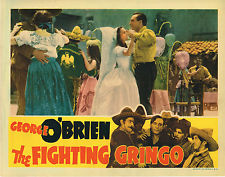
Tonight's Movies: Arizona Legion (1939) and The Fighting Gringo (1939) - Warner Archive DVD Reviews

I've loved the Warner Archive's nine-film George O'Brien Western Collection so much I haven't wanted the movies to come to an end!

It was finally time to watch the last two films in the set, the RKO Westerns ARIZONA LEGION (1939) and THE FIGHTING GRINGO (1939).

ARIZONA LEGION was one of three films in which O'Brien costarred with Laraine Day, then billed as Laraine Johnson. They're an appealing couple, and hopefully their other two films, BORDER G-MAN (1938) and PAINTED DESERT (1938), will be brought out on DVD by the Warner Archive at a future date.

This was the last of O'Brien's films with Day; later in the year she left RKO for MGM and began playing Nurse Mary Lamont in CALLING DR. KILDARE (1939) and later films in the Kildare series. Just 18 months after the release of ARIZONA LEGION, Day was starring in Alfred Hitchcock's FOREIGN CORRESPONDENT (1940).

Day plays Letty, who is completely dismayed by the inexplicable behavior of her fiance, Boone (O'Brien); Boone has taken to juvenile behavior like shooting up things in town for fun and hanging out with the wrong crowd. It gets so bad that Letty eventually gives him back her ring.

Unbeknownst to Letty, Boone is working undercover to infiltrate a gang of robbers, and the governor has made him captain of the first group of Arizona Rangers.

O'Brien was more than two decades older than his leading lady but the difference is really not apparent, especially with the ultra-athletic O'Brien jumping onto his horse without stirrups and jumping off of a stagecoach. They have a nice chemistry, even with most of their early scenes spent arguing; I love the way Day's eyes sparkle when she realizes the truth about her errant fiance.

The supporting cast includes Chill Wills, Carlyle Moore, Tom Chatterton, Harry Cording, Monte Montague, Bob Burns, and Glenn Strange, who was also in THE FIGHTING GRINGO. The movie runs 58 minutes.

ARIZONA LEGION was directed by David Howard. It was filmed by Harry J. Wild at Southern California locations including Corriganville and the Iverson Ranch.

The print was occasionally lightly scratched but on the whole it looks quite good.

It was amazing to revisit THE FIGHTING GRINGO (1939) knowing that leading lady Lupita Tovar just celebrated her 106th birthday! You read that correctly.

In an interview Tovar called George O'Brien "a sweetheart; we were very, very good friends...[O'Brien's] daughter, Orin O’Brien, and my daughter, Susan Kohner, who is a little younger than Orin, were childhood friends and are still friends today! Orin has been playing bass with the New York Philharmonic since 1966. When they were little girls we’d go to the O’Brien ranch for the weekend. They still see each other often."

O'Brien plays Wade Barton, who saves the life of a pretty senorita named Anita (Tovar) and helps her father (Lucio Villegas) when he's forced off his land by Ben Wallace (William Royle). Wallace is so dastardly that he also kills the brother (LeRoy Mason) of his own fiancee (Mary Field) in order to gain her family's land as well!

This is a most pleasing O'Brien Western with lots of great atmosphere, from the opening sequence of cowboys singing to the unique "shower" system owned by the barber (Cris-Pin Martin) to the Mexican Hat Dance performed at a fiesta.

As someone who watches many "B" Westerns, I also enjoyed the familiar sets. The ranch owned by Mary Field has been seen in countless movies. Incidentally, the movie provides Field with a very good role.

Another of the really fun things about the movie is spotting future Oscar winner Ben Johnson in a Mexican cantina. You can pick out the baby-faced Johnson over O'Brien's shoulder. Johnson was only 20 or 21 at the time, and this was his very first movie! IMDb also credits Johnson with stunt work. A decade later O'Brien and Johnson would each play significant supporting roles in John Ford's classic SHE WORE A YELLOW RIBBON (1949), which was just released on Blu-ray by the Warner Archive; my recent review is here.

THE FIGHTING GRINGO was directed by David Howard. It was filmed by Harry J. Wild and runs 59 minutes.

I have previously reviewed ARIZONA LEGION here and THE FIGHTING GRINGO here. Both reviews were written in 2013.

THE FIGHTING GRINGO had an occasional scratch but was for the most part an excellent print, probably even better than ARIZONA LEGION.

There are no extras with either film.

The George O'Brien Western Collection is one of my all-time favorite Warner Archive releases, which I'll be returning to many times in the years to come. Most highly recommended.

Previous reviews of films in the George O'Brien Western Collection: LAWLESS VALLEY (1938), RACKETEERS OF THE RANGE (1939), TIMBER STAMPEDE (1939), TROUBLE IN SUNDOWN (1939), PRAIRIE LAW (1940), STAGE TO CHINO (1940), and BULLET CODE (1940).

Thanks to the Warner Archive for providing a review copy of this DVD collection. Warner Archive releases are MOD (manufactured on demand) and may be ordered from the Warner Archive Collection Store at Amazon and from other online retailers.

Thursday, June 04, 2015

Tonight's Movie: Stage to Chino (1940)

It's been over a year since I last watched a Western starring the appealing team of George O'Brien and Virginia Vale. Tonight I finally caught STAGE TO CHINO (1940), the last of their half-dozen films together for RKO which I needed to see.

In this action-packed film Caroline (Vale) is trying to secure a mail contract for her stage line. She's being plotted against by her Uncle Charlie (Carl Stockdale) and Dude Elliott (Roy Barcroft).

O'Brien plays Dan Clark, an undercover postal inspector who gets to the bottom of the nefarious goings-on, unexpectedly aided by a traveling salesman (Hobart Cavanaugh). The sooner Dan solves the ongoing crimes, the quicker he can spend his time romancing lovely Caroline!

This is a typically enjoyable O'Brien-Vale entry, with perhaps O'Brien's most impressive stuntwork of the series. During a big barroom brawl sequence he jumps up on the bar and swings from a lantern! Even more impressive, he transfers from one moving stagecoach to another, and it's shot in such a way that there is no doubt it's the athletic O'Brien doing his own stunt work.

In Boyd Magers' book WESTERNS WOMEN, Vale confirms that O'Brien did the stagecoach stunt work himself and said, "I never saw him use a double. He was a superb athlete and very strong. He picked me up like I was a feather."

Vale also said STAGE TO CHINO was her favorite of their six films together. She liked her role, and what's more, she convinced the producer to let her design her dresses! To that point she'd always been assigned generic clothes from the wardrobe department. She made some sketches, chose the fabric, and the wardrobe department made them up for her. (There's an especially notable scene where she models a lovely new dress for O'Brien.) She said, "They were reused, I've seen them time and time again in Westerns." I wonder if any of them turned up worn by the leading ladies in Tim Holt Westerns!

The supporting cast of STAGE TO CHINO includes Glenn Strange, William Haade, Harry Cording, Martin Garralaga, and Ethan Laidlaw. Music is provided by Pals of the Golden West, headed by the yodeling Nora Lou Martin.

STAGE TO CHINO was directed by Edward Killy and filmed by J. Roy Hunt. The movie runs 59 minutes.

In response to a letter I sent the Warner Archive for their podcast, George Feltenstein and his colleagues indicated that at some point in the future there will be more George O'Brien Westerns on DVD. Hopefully the three O'Brien-Vale Westerns which aren't yet out will be in a future collection.

Reviews of all five of the other George O'Brien-Virginia Vale films: THE MARSHAL OF MESA CITY (1939), LEGION OF THE LAWLESS (1940), BULLET CODE (1940), PRAIRIE LAW (1940), and TRIPLE JUSTICE (1940).

February 2016 Update: STAGE TO CHINO is now available on DVD from the Warner Archive in the nine-film George O'Brien Western Collection!

June 2016 Update: My review of STAGE TO CHINO in the George O'Brien Western Collection is here.

Sunday, September 08, 2013

Tonight's Movie: Bullet Code (1940)

My happiest movie discoveries this past year would have to include George O'Brien's RKO Westerns.

O'Brien's sunny, capable cowboy persona gives the viewer an "all's right with the world" feeling, and BULLET CODE is no exception. This 58-minute film, teaming O'Brien with frequent leading lady Virginia Vale, is a strong, entertaining entry in the series.

The plot is standard Western melodrama, with the nasty banker (Walter Miller) plotting to drive rancher John Mathews (Howard Hickman) and his lovely daughter, Miss Molly (Vale), off their ranch.

Enter Steve Holden (O'Brien) and his sidekick Pop (Slim Whitaker). Steve harbors some guilt over involvement in the death of Molly's brother (Robert Stanton, aka Kirby Grant), not knowing for certain that it was actually some of the same villains working with the banker who did the deed.

Steve and Pop work to bring the bad guys to justice, while in quiet moments Steve and Molly exchange subtle glances of interest. The lovely final shot is Steve and Molly gazing at one another in the distance, clearly planning their future together on the ranch, as Mr. Mathews and Pop duet "Here Comes the Bride" on harmonica.

That story may not sound like much, but it's such fun to step into the world of one of these O'Brien Westerns for an hour. He's sort of a Western "Superman," a large man of great strength who hurls bad guys around with ease; he has an impish mischievous streak, but he's an honorable, responsible man who protects the vulnerable and won't back down from a fight.

At the same time, O'Brien's characters feel "real" and possible, rather than the stuff of fantasy. It's rather nice to be reminded that there are good men like him in the world, and I imagine the audiences of 1940, watching as war clouds gathered, must have thought so too. (This is a good place to mention that O'Brien would go on to be a decorated Naval officer during WWII, and he would serve in the Naval Reserves until the early '60s.)

This is one of six films in which O'Brien and Vale were costarred. O'Brien was also nicely teamed with Laraine (Johnson) Day and Marjorie Reynolds, but I find his movies with Vale most appealing; they have a sweet, natural chemistry together.

In Boyd Magers' fascinating book of interviews, WESTERNS WOMEN, Vale said, years later, "George was just a gem of a fellow. I thought he was just wonderful." She also said, "I never saw him use a double. He was a superb athlete and very strong. He picked me up like I was a feather."

She commented that O'Brien was "a very, very good actor...unless the scene is really serious, he played it lightly with a twinkle in his eye. Did you ever notice he hardly ever just walked out of a scene? He usually finished it with a gesture, a look, or a throw-away line, all of which were probably his idea and not in the script or suggested by the director."

I particularly noticed that "scene finishing" technique of O'Brien's in this film, such as the amused "double look" he gives Pop when the older man suggests Steve buy Molly peppermint drops, or the "What can we do?" shrug he gives Pop when they are forced to leave the Mathews ranch. These little reaction moments enable O'Brien to convey to the viewer a great deal about his character's personality within a very short running time. The stories in these "B" Westerns may be run of the mill, but the performances aren't.

BULLET CODE was directed by O'Brien's regular director, David Howard. It was filmed by Harry J. Wild at the Iverson Ranch. I've seen so many Westerns this year, it's getting so I recognize the Western streets and ranch houses which appear in movie after movie!

The supporting cast includes Harry Woods, William Haade, Bob Burns, and a group of musicians in the opening scene comprised of Spade Cooley, Johnny Luther, and Rudy Sooter.

This movie isn't out on DVD, but since the Warner Archive previously released a three-film set with half the O'Brien-Vale movies, perhaps we can look forward to another set with the rest in the future.

In the meantime, BULLET CODE has been shown on Turner Classics Movies and is likely to turn up there again at some point in the future.

February 2016 Update: BULLET CODE is now available on DVD from the Warner Archive in the nine-film George O'Brien Western Collection. My review of the DVD is here.

Previous reviews of George O'Brien "B" Westerns: THE RENEGADE RANGER (1938), GUN LAW (1938), PAINTED DESERT (1938), BORDER G-MAN (1938), ARIZONA LEGION (1939), TIMBER STAMPEDE (1939), THE FIGHTING GRINGO (1939), THE MARSHAL OF MESA CITY (1939), and LEGION OF THE LAWLESS (1940).

Tuesday, June 21, 2016

Tonight's Movies: Prairie Law (1940) and Stage to Chino (1940) - Warner Archive DVD Reviews

It's been a busy few days, which made it the perfect time to relax with more films from the Warner Archive George O'Brien Western Collection.

This time around I watched two more of O'Brien's films with Virginia Vale, PRAIRIE LAW (1940) and STAGE TO CHINO (1940). I'd seen this pair in the past, and like most of O'Brien's Westerns, they hold up very well on further acquaintance.

PRAIRIE LAW is an engaging, well-scripted tale in which O'Brien plays Brill Austin, who helps a bunch of homesteaders who have been tricked into buying land without access to water. One of the settlers is lovely Priscilla (Vale), and the pair are soon bantering and flirting in between dealing with water rights, cattle rustlers, and a fraudulent election to move the county seat.

I previously reviewed this one in 2014, and this time around I liked it just as much, if not more, than I did then. O'Brien and Vale are always fun to watch, and there's some genuinely amusing dialogue. One of my favorite bits involves a jury simultaneously conducting deliberations and participating in a shootout!

An added plus is that, as was often the case in these films, George O'Brien handled his own stunts in an extended fight sequence, including a backwards somersault and flipping someone over his shoulder.

The excellent cast includes Slim Whitaker, J. Farrell MacDonald, Dick Hogan, Cy Kendall, Paul Everton, Lloyd Ingraham Henry Hall, Monte Montague, and Hank Worden. Look for a young Darryl Hickman as a homesteader's son.

PRAIRIE LAW was directed by David Howard. It was filmed in black and white by J. Roy Hunt and the uncredited Harry J. Wild. The running time is 59 minutes.

While in PRAIRIE LAW Vale's character mostly roots from the sidelines, she has a strong role in STAGE TO CHINO as Caroline McKay, the spunky owner of a stage line. Caroline is trying to secure a mail contract, but she's being plotted against by her own uncle (Carl Stockdale) and by Dude Elliott (Roy Barcroft), who owns much of the town.

O'Brien plays Dan Clark, an undercover postal inspector, who's aided by a traveling salesman (Hobart Cavanaugh).

As I mentioned in my 2015 review, STAGE TO CHINO was Vale's favorite of her half-dozen films with O'Brien, and it's easy to see why. She had a good role, even driving a stagecoach, and in addition to that, she designed her own wardrobe! Tired of off the rack dresses from the studio wardrobe department, she made sketches and chose the fabric for dresses the wardrobe department made up for her; the dresses then went into the studio's inventory and were reused. Vale said, "I've seen them time and time again in Westerns."

O'Brien has some especially great stuntwork in this one, swinging from a chandelier and also transferring from one moving stagecoach to another, which Vale -- who was also in the shot -- later confirmed O'Brien did himself.

The STAGE TO CHINO cast includes Glenn Strange, William Haade, Harry Cording, Martin Garralaga, and Ethan Laidlaw, plus music from Nora Lou Martin and the Pals of the Golden West.

STAGE TO CHINO was directed by Edward Killy and filmed by J. Roy Hunt. It runs 59 minutes.

PRAIRIE LAW and STAGE TO CHINO are good-looking prints. There are no extras.

With this latest pair of films I've now seen seven of the nine films which comprise the George O'Brien Western Collection. Links to previous reviews of films in this set: LAWLESS VALLEY (1938), RACKETEERS OF THE RANGE (1939), TIMBER STAMPEDE (1939), TROUBLE IN SUNDOWN (1939), and BULLET CODE (1940).

The George O'Brien Western Collection is one of my all-time favorite Warner Archive releases. Fingers crossed that a final set of O'Brien's RKO Westerns will be released in the future, including the two remaining films he made with Laraine (Johnson) Day, BORDER G-MAN (1938) and PAINTED DESERT (1938), plus GUN LAW (1938) with Rita Oehmen, who was the mother of Charmian Carr of THE SOUND OF MUSIC (1965)

Thanks to the Warner Archive for providing a review copy of this DVD collection. Warner Archive releases are MOD (manufactured on demand) and may be ordered from Amazon and other online retailers.

Wednesday, October 02, 2013

Tonight's Movie: Triple Justice (1940)

TRIPLE JUSTICE is a superior George O'Brien Western. It follows THE MARSHAL OF MESA CITY (1939) and LEGION OF THE LAWLESS (1940) as the concluding film in a three-film O'Brien Westerns set from the Warner Archive.

I smiled with anticipation as TRIPLE JUSTICE began with the familiar beeping RKO logo, followed by a sharp-looking credits sequence which made clear that this would be yet another gorgeous O'Brien print from the Archive. This black and white movie, shot by J. Roy Hunt, looks terrific, and I'm so appreciative of the quality presentation a "B" Western like this receives from the Archive.

The tale begins when Brad Henderson (O'Brien) arrives in town for the wedding of his best friend, Sheriff Bill Gregory (LeRoy Mason) to Susan (Peggy Shannon).  Brad is caught up in a bank robbery and mistaken for one of the outlaws. Unfortunately Sheriff Gregory is shot by the robbers and unconscious for an extended period, so he's unable to identify Brad.

Unbeknownst to Brad, the sheriff's deputy, Al Reeves (Harry Woods), is in cahoots with the outlaws, which explains why he doesn't seem very interested in seeing that Brad's name is cleared. Brad has no choice but to escape and try to clear his name. He sets out after each of the three outlaws he knows by sight -- hence the movie's title.

One of the outlaws (Malcolm McTaggart) just happens to have a charming sister, Lorna (Virginia Vale), who is so taken with the handsome "outlaw" she finds sleeping in her barn that she can't bring herself to turn him in.

TRIPLE JUSTICE squeezes a lot of story into its 66-minute running time, along with excellent location shooting and several musical numbers. Some of the movie was shot in Lone Pine, but the film's most striking sequence finds Brad trailing one of the outlaws (Paul Fix) across Death Valley. It's quite a memorable sequence.

The second half of the film is very musical, with the Lindeman Sisters as pretty senoritas singing two songs at a hacienda south of the border. Meanwhile O'Brien listens as Virginia Vale sings "Lonely Rio," cowritten by Ray Whitley and Fred Rose; although he's not in TRIPLE JUSTICE, Whitley was one of O'Brien's regular sidekicks at RKO and also starred with Vale in a series of musical shorts. Whitley's most famous composition was "Back in the Saddle Again."

This was O'Brien's last of six films with Vale and his last Western under contract to RKO. In Boyd Magers' WESTERNS WOMEN, Virginia Vale mused, "I have no real information, but I think RKO knew maybe halfway through this series of six that they were going to drop George. After all, he was 40 or 41 years old. He still had a wonderful physique, but he was no longer really slim and young, the way most of the cowboy stars were at that time. That might be one reason why, at the end of the six pictures, George and I got married in TRIPLE JUSTICE. You know, closing it out."

Vale also said that O'Brien's longtime director, David Howard, "was a very kind man. Very patient...He was a very soft-spoken man. In fact, I don't remember anybody who was connected with any of the Westerns who wasn't soft-spoken. Everybody was just polite." She said of Harry Woods, who plays the chief villain, "What a meanie he would be, always after the girl or after the mine or after something. Very good."

More of Vale's thoughts on her experiences working with George O'Brien are included in my review of BULLET CODE (1940). I highly recommend Magers' book, which has many other interesting interviews.

O'Brien has a hilarious scene with Hank Worden, who often turned up in bit roles in O'Brien's Westerns. The cast also includes Glenn Strange, Jean Del Val, Wilfred Lucas, and Robert McKenzie.

TRIPLE JUSTICE would be O'Brien's last film until after World War II, other than providing a voice for the Naval film December 7th (1943). O'Brien, who had served in the Navy during WWI, re-enlisted and was a decorated officer during WWII. After the war he continued to focus on his Naval career, serving during Korea and continuing in the Naval Reserves until the '60s. He appeared in just a handful of post-WWII films including MY WILD IRISH ROSE (1947) and John Ford's FORT APACHE (1948), SHE WORE A YELLOW RIBBON (1949), and CHEYENNE AUTUMN (1964).

Previous reviews of George O'Brien "B" Westerns: THE RENEGADE RANGER (1938), GUN LAW (1938), PAINTED DESERT (1938), BORDER G-MAN (1938), ARIZONA LEGION (1939), TIMBER STAMPEDE (1939), THE FIGHTING GRINGO (1939), THE MARSHAL OF MESA CITY (1939), LEGION OF THE LAWLESS (1940), and BULLET CODE (1940).

Wednesday, January 08, 2014

Tonight's Movie: Prairie Law (1940)

PRAIRIE LAW is another very enjoyable George O'Brien RKO Western, teaming O'Brien with frequent leading lady Virginia Vale.

This time around O'Brien plays Brill Austin, a rancher helping some homesteaders, including lovely Priscilla (Vale), with water rights after the bad guys sell the newcomers land without access to water.

It all gets a little complicated, with shenanigans involving cattle rustling, fake elections, and moving the county seat, but Brill and his friends soon set matters right and by the end he's also won pretty Priscilla.

It's an action-packed 59 minutes. Along the way there's a scene with some lovely Western music, and there's also a clever, amusing sequence where a jury conducts its deliberations while also taking part in a shootout.

The cast includes J. Farrell MacDonald, Dick Hogan, Cy Kendall, Paul Everton, Henry Hall, and Monte Montague. Hand Worden has a small role as a man buying land.

In Boyd Magers' WESTERNS WOMEN Virginia Vale recalled Slim Whitaker, who plays O'Brien's sidekick Silent, as "Another very fine man...he always played his character very well."

More quotes from Vale about her experiences working on the O'Brien Westerns can be found here and here. She had nothing but good things to say about O'Brien, director David Howard, and the other actors she worked with.

Some fascinating trivia about Virginia Vale is that after her film career, she served for decades as a competition judge for the U.S. Figure Skating Assocation. The Los Angeles Figure Skating Club published an obituary for Vale in their December 2006 newsletter, The Ice Monitor.

Cinematography of PRAIRIE LAW was by J. Roy Hunt. IMDb also says there was uncredited photography by Harry J. Wild.

PRAIRIE LAW isn't yet on DVD, but I'm hoping the Warner Archive will release a second collection with the rest of the six movies teaming O'Brien with Virginia Vale, since three of them are already available in a very nice set.

PRAIRIE LAW been shown on Turner Classic Movies.

February 2016 Update: PRAIRIE LAW is now available on DVD from the Warner Archive in the nine-film George O'Brien Western Collection.

June 2016 Update: My review of PRAIRIE LAW in the George O'Brien Western Collection is here.

Previous reviews of George O'Brien-Virginia Vale Westerns: THE MARSHAL OF MESA CITY (1939), LEGION OF THE LAWLESS (1940), BULLET CODE (1940), and TRIPLE JUSTICE (1940). Now that I've seen PRAIRIE LAW, the only one of O'Brien and Vale's joint films which I haven't tracked down is STAGE TO CHINO (1940).

Saturday, March 19, 2016

Tonight's Movie: Bullet Code (1940) - A Warner Archive DVD Review

BULLET CODE (1940), a favorite George O'Brien Western, is one of nine titles in the George O'Brien Western Collection. The set was recently released by the Warner Archive.

O'Brien teamed with actress Virginia Vale for six films, half of which were previously released in a three-film George O'Brien Collection, also available from the Archive. Their remaining films are all included in this brand-new set.

O'Brien had some excellent leading ladies, including Marjorie Reynolds and Laraine (Johnson) Day, but I especially enjoy the pairing of O'Brien and Vale, whose chemistry has a little extra spark to it. Indeed, in an interview Vale once described O'Brien as "a gem of a fellow," and she clearly loved working with him.

The talented Vale could sing and, tired of the dresses from RKO's wardrobe department, she even designed her wardrobe for another O'Brien Western, STAGE TO CHINO (1940)! She was also a competitive figure skater in the early '40s, and after retiring from films in 1945, she spent over 50 years as a judge for the U.S. Figure Skating Association.

In this 58-minute film, O'Brien plays Steven Holden, a cattle drive foreman who accidentally shoots young Bud Mathews (Robert Stanton, later known as Kirby Grant), or so he thinks. Bud, who had gotten into trouble colluding with some cattle rustlers, was really killed by some bad guys who, as it happens, were working for the banker (Walter Miller) trying to steal Bud's father's ranch!

Steve goes to visit Bud's father (Howard Hickman) and sister Molly (Vale) and immediately pitches in to help save their ranch and bring the villains to justice. The bad guys include frequent O'Brien villain Harry Woods, always so good as a heavy.

I view BULLET CODE as a model "B" Western, fast-moving and engaging, with good action scenes, a bit of comedy, a little music, and a touch of romance. What more could a fan want?

For more background on this film, including quotes by Virginia Vale, please visit my 2013 review.

BULLET CODE was directed by David Howard. The movie was shot in black and white by Harry J. Wild.

The supporting cast includes Slim Whitaker, William Haade, and Bob Burns. Musicians in the movie's first scene included Spade Cooley on the fiddle.

Howard Hickman, who plays Virginia Vale's father, played countless doctors, judges, professors, and military officers in his long career. GONE WITH THE WIND fans may recognize him, as the year previous to BULLET CODE, Hickman played John Wilkes, the owner of Twelve Oaks and father to Ashley (Leslie Howard).

Previous reviews of films in the George O'Brien Western Collection: LAWLESS VALLEY (1938), RACKETEERS OF THE RANGE (1939), TIMBER STAMPEDE (1939), and TROUBLE IN SUNDOWN (1939).

The BULLET CODE print is for the most part very good. There was one brief scene which was noticeably darker and rougher than the others. There are no extras.

Thanks to the Warner Archive for providing a review copy of this DVD collection. Warner Archive releases are MOD (manufactured on demand) and may be ordered from the Warner Archive Collection Store at Amazon and from other online retailers.

Friday, July 05, 2013

Tonight's Movie: The Renegade Ranger (1938)

What could be better than a George O'Brien or Tim Holt Western? How about a Western starring both O'Brien and Holt, plus Rita Hayworth?

That movie is 1938's THE RENEGADE RANGER. O'Brien and Holt play Texas Rangers who end up on opposite sides of the law when Larry (Holt) is kicked out of the Rangers for "conduct unbecoming" after one brawl too many.

Larry joins forces with Judith Alvarez (Hayworth), who is accused of having committed murder. In reality, Alvarez is one of a number of border ranchers unjustly forced off their land by evil tax collector Ben Sanderson (William Royle). Jack (O'Brien) is charged with bringing Judith to justice but ultimately ends up protecting her from Sanderson and his men.

THE RENEGADE RANGER isn't the best of O'Brien and Holt's "B's," but it's fun and very fast-paced, running just 59 minutes. Ray Whitley and the Phelps Brothers are also along for the ride, providing a nice musical break, and Cecilia Callejo, as Holt's sweetheart, sings and dances with castanets. I enjoyed her -- yet couldn't help wishing Rita were dancing instead!

Rita is lovely, though still years away from her '40s superstar status. I've always been a big Hayworth fan, with YOU WERE NEVER LOVELIER (1942), COVER GIRL (1944), and TONIGHT AND EVERY NIGHT (1945) among the earliest films I saw at L.A. revival theaters as a child in the '70s. It's fun to catch her in her early roles.

THE RENEGADE RANGER launched Tim Holt's career as the star of RKO "B" Westerns; Holt would star in well over 40 such Westerns between 1938 and 1952, while simultaneously appearing in "A" titles such as THE MAGNIFICENT AMBERSONS (1942), MY DARLING CLEMENTINE (1946), and THE TREASURE OF THE SIERRA MADRE (1948). Holt was also a decorated member of the Air Corps during WWII.

George O'Brien continued making RKO Westerns through 1940. A Naval veteran of WWI, he reenlisted with the Navy in WWII and from that point on the Navy was the main focus of his career, serving until the 1960s.

O'Brien made just five more films after WWII, three of which were for his longtime colleague, director John Ford: FORT APACHE (1948), SHE WORE A YELLOW RIBBON (1949), and CHEYENNE AUTUMN (1964). Ford had previously directed O'Brien in THE IRON HORSE (1924) and SEAS BENEATH (1931).

Some further biographical notes of interest on George O'Brien: His daughter Orin has played bass with the New York Philharmonic since 1966, and his son Darcy, who died in 1998, was a prolific author whose many books included a biography of Pope John Paul II. Orin and Darcy's mother was actress Marguerite Churchill.

THE RENEGADE RANGER was directed by David Howard and filmed by Harry J. Wild at the Iverson Ranch.

THE RENEGADE RANGER can be seen in an excellent print as part of the Warner Archive's Tim Holt Western Classics Collection, Vol. 1.

THE RENEGADE RANGER can also be seen on Turner Classic Movies.

Previous reviews of George O'Brien Westerns: GUN LAW (1938), PAINTED DESERT (1938), THE MARSHAL OF MESA CITY (1939), and LEGION OF THE LAWLESS (1940).

Previous reviews of Tim Holt Westerns: THUNDER MOUNTAIN (1947), RIDERS OF THE RANGE (1950), STORM OVER WYOMING (1950), RIDER FROM TUCSON (1950), and BORDER TREASURE (1950).

‹Older