Saturday, September 20, 2014

Tonight's Movie: Texas Lawmen (1951) - A Warner Archive DVD Review

TEXAS LAWMEN (1951) is another solid Johnny Mack Brown Western which is part of the Monogram Cowboy Collection, Vol. 1, from the Warner Archive.

Brown stars as Marshal Johnny Mack Brown, sent to a small, dusty town to attempt to solve the murder of the sheriff (Pierce Lyden) by stage robbers he was chasing.

Johnny meets the acting sheriff, young Tod Merrick (James "Jimmy" Ellison), who's nice enough yet seems to be hiding a secret. Turns out it's quite a big secret indeed.

TEXAS LAWMEN has a tight 54-minute screenplay which, unlike the last Brown Western I watched, isn't overly padded with shots of people racing around on horseback. There are some such scenes, notably the opening stagecoach robbery, but the ratio of horseback riding to dialogue seemed more appropriate this time around!

The Joseph Poland screenplay was based on a story by longtime Western character actor Myron Healey, who also wrote the screenplay for Johnny Mack Brown's COLORADO AMBUSH (1951). Healey costarred in COLORADO AMBUSH. These two films were his only writing credits. It's so interesting to discover an actor like Healey was a man of multiple talents!

As in the other two Brown Westerns seen to date, Lyle Talbot turns up in a small role, this time around as the town doctor. The cast also includes reliable veterans I. Stanford Jolley and Lee Roberts as bad guys.

Brown once more does his own fight scene; he does these very well indeed. I rewound a scene where he takes a fall off his horse and rolls downhill, and there was a quick, unobtrusive cut to the stuntman for that one.

An oops: The sign at the marshal's office reads "Marshall's" with an extra L.

TEXAS LAWMEN was directed by Lewis Collins. It was shot in black and white by Ernest Miller.

Like the other Brown films seen to date from this DVD set, the picture and sound quality are excellent.

I'm really enjoying Brown's Monogram Westerns and look forward to seeing more.

Previous films reviewed from this set: Johnny Mack Brown in OKLAHOMA JUSTICE (1951) and MAN FROM SONORA (1951), along with Rod Cameron in CAVALRY SCOUT (1951).

Thanks to the Warner Archive for providing a review copy of this DVD collection. Warner Archive releases are MOD (manufactured on demand) and may be ordered from Amazon and other online retailers.

Sunday, September 07, 2014

Tonight's Movie: Oklahoma Justice (1951) - A Warner Archive DVD Review

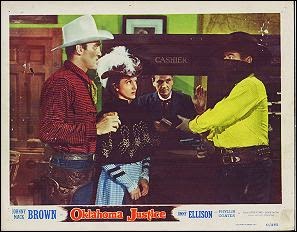
OKLAHOMA JUSTICE is a Johnny Mack Brown "B" Western in the Monogram Cowboy Collection, Vol. 1, put out by the Warner Archive.

This is the second "Johnny Mack" Western I've reviewed from the set, and while not quite as strong as MAN FROM SONORA (1951), I enjoyed OKLAHOMA JUSTICE quite well. The Brown Westerns are pleasingly made, sturdy Western entertainment, and I look forward to seeing more.

A trio of bad guys have been holding up banks, and Sheriff Barnes (Kenne Duncan) and stage employee Jimmy (James "Jimmy" Ellison) sit down to concoct a plan to deal with it. Next thing we know, our hero Johnny Mack Brown shows up in town and robs the bank. This is more than a little confusing for a couple of minutes, until the viewer eventually realizes it's part of an elaborate undercover ruse so that Johnny Mack can ingratiate himself with the bad guys.

The ring is headed by Ma Posey (Barbara Allen, also known as Barbara Woodell), who acts sweet as can be to the sheriff, trying to pump him for information, but in reality she's quite nasty, barking out orders for robberies -- and worse. Allen played Zee James in Samuel Fuller's I SHOT JESSE JAMES (1949), and she reprised that role in THE GREAT JESSE JAMES RAID (1953). She passed on in 1997.

The jig is nearly up when Goldie (Phyllis Coates) realizes that it was Johnny Mack who robbed the bank and "killed" her fiance, the teller (Bruce Edwards). One of the only problems with the plot is Goldie's initial calm demeanor over the death of the man she loves, but she later proves to be quite resourceful. As was the case in MAN FROM SONORA, Coates brings an energetic intelligence to her part.

James Ellison, of so many RKO films of the late '30s and early '40s, makes a lively sidekick for Johnny Mack. I have a VCI set of Westerns Ellison made with Julie Adams which I look forward to watching. According to IMDb, when "B" Westerns faded out Ellison had a very successful second career in real estate and home construction, and Ellison Drive in Beverly Hills was named in his honor. A Drifting Cowboy has photos from several of Ellison's Westerns.

Lyle Talbot, who played the sheriff in MAN FROM SONORA (1951), turns up here as the town doctor. I enjoy having faces such as Talbot's pop in for a few minutes. A quick glance at Talbot's credits shows he played supporting roles in many other Monogram Westerns of the era.

Some interesting notes on OKLAHOMA JUSTICE: There's a curious moment in the opening scene when one of the bank robbers is clearly having trouble getting on a spooked horse, but valiantly keeps going so as not to ruin the shot, finally getting into the saddle at the last moment. I rewound to watch it a second time!

As with MAN FROM SONORA, many of the scenes have a bit of a haze and seem to have been shot in the early morning hours; maybe the crew was shooting during California's perennial morning "June gloom"!

The only real issue with this 56-minute film, as a reviewer at IMDb correctly notes, is that it is padded with way too many shots of people racing around on horseback. It got to the point where I hit fast-forward a couple times, seeing no need to keep watching galloping horses at normal viewing speed!

OKLAHOMA JUSTICE was directed by Lewis D. Collins and shot by Ernest Miller. The supporting cast includes Lane Bradford, I. Stanford Jolley, and Marshall Reed.

The OKLAHOMA JUSTICE print looks great, and it also has excellent sound quality; those gunshots really pop in the final shooting matches. It's such a pleasure to have a film like this so nicely preserved thanks to the Warner Archive. There are no extras.

Previous films reviewed from this set: Johnny Mack Brown in MAN FROM SONORA (1951) and Rod Cameron in CAVALRY SCOUT (1951).

Thanks to the Warner Archive for providing a review copy of this DVD collection. Warner Archive releases are MOD (manufactured on demand) and may be ordered from Amazon and other online retailers.

Sunday, December 07, 2014

Tonight's Movie: Law of the Panhandle (1950) - A Warner Archive DVD Review

The Warner Archive's Monogram Cowboy Collection, Volume 3, is a three-disc set of nine films starring Johnny Mack Brown.

I have now seen and enjoyed all of Brown's films from the Monogram Volume 1 and Volume 2 Collections so I was excited to see more of his films in the third set.

I began with the last movie in the collection, LAW OF THE PANHANDLE (1950), which I was curious to see as leading lady Jane Adams was also in the last Brown Western I reviewed, OUTLAW GOLD (1950).

Adams plays Margie, who is sweet on the sheriff (Riley Hill) contending with a series of local robberies and other acts of terror, including ranchers being burned out of their homes. Unable to solve the problems on his own, the sheriff requests federal help, which arrives in the person of U.S. Marshal Johnny Mack Brown.

Johnny gets to work sorting through the suspects and soon uncovers the motive; the villain is trying to drive out local settlers and buy up their land because a railroad will be passing through nearby.

The movie is par for the course with Brown's Westerns; they may not reach the polished level of a Tim Holt Western, and some of the supporting cast's acting is at times endearingly awkward, but I simply like 'em. Brown makes a genial and reassuring lawman; later in his career he might not have had conventional leading man looks, but the one-time football player very clearly does his own fight scenes much of the time which adds to the realism.

The Warner Archive print is in terrific shape, which made viewing the film a pleasure.

I wrote more about the interesting life of leading lady Jane Adams in my review of OUTLAW GOLD from the Monogram Cowboy Collection, Vol. 1. In the book WESTERNS WOMEN by Boyd Magers she described Johnny Mack Brown as "a real gentleman from the South with all the charm in the world. He was the one I enjoyed the most."

The cast of LAW OF THE PANHANDLE includes Myron Healey and Marshall Reed. This 55-minute film was directed by Lewis D. Collins and photographed in black and white by Harry Neumann.

I'll be reviewing additional Johnny Mack Brown films from this set in the weeks to come, along with Jimmy Wakely and Whip Wilson films from Volumes 1 and 2.

Thanks to the Warner Archive for providing a review copy of this DVD collection. Warner Archive releases are MOD (manufactured on demand) and may be ordered from Amazon and other online retailers.

Sunday, April 20, 2025

Tonight's Movie: Western Renegades (1949) - A Warner Archive Blu-Ray Review

Dreams do come true, and that was certainly the case when the Warner Archive Collection recently released the Monogram Matinee Volume 1 collection on Blu-ray!

This set consists of three Monogram "B" Westerns, all released in 1949: WESTERN RENEGADES (1949) with Johnny Mack Brown, CRASHING THRU (1949) with Whip Wilson, and MISSISSIPPI RHYTHM (1949) starring Jimmie Davis. This collection was certainly a wonderful surprise, and I hope we'll see more volumes in the future.

I've enjoyed several Johnny Mack Brown Westerns in the past, but it's been quite a while, so I chose to start my viewing with that one. WESTERN RENEGADES is a 59-minute film which was directed by Wallace Fox and written by Adele Buffington.

I'll add here that it's interesting to note, given both the era and the genre, that all three films in this set were written by women.

The plot of WESTERN RENEGADES is somewhat convoluted, with fake identities galore. Marshal Johnny Mack Brown (Brown) is headed to Gordontown to visit his old friend, Dusty Dekker (Steve Clark).

On the way he saves a brother and sister, Joe (Riley Hill) and Judy (Jane Adams), who live in Gordontown from some murderous bad guys. When everyone arrives in Gordontown, they learn that Dusty has been accused of murdering Joe and Judy's father Paul (Marshall Bradford).

It's all part of a plot by Jim Larren (Hugh Prosser) and others to steal control of land in Gordtown. The bad guys have even hired an actress (Constance Worth) to play Joe and Judy's long-lost mother, who will ostensibly inherit their ranch.

Like many films of this type, this is nothing particularly special, but it's an agreeable hour headed by the genial Brown, who's always one step ahead of the bad guys. Perfect relaxed Sunday afternoon viewing.

Among the supporting cast I especially enjoyed Jane Adams, a "B" Western leading lady who also worked with Brown in LAW OF THE PANHANDLE (1950) and the previously reviewed OUTLAW GOLD (1950). Both of those later films were released on DVD in Monogram Cowboy Collections from the Warner Archive.

The supporting cast of WESTERN RENEGADES also includes Max Terhune, Marshall Reed, and Myron Healey.

WESTERN RENEGADES was filmed in black and white by Harry Neumann. Location shooting was done in Santa Clarita, California.

As an aside, last year I finally located the spot where Johnny Mack Brown is interred with his daughter at Forest Lawn Glendale; I shared a photograph in my Classic Movie Hub Western RoundUp column. It was a nice moment pausing to pay my respects to someone whose work continues to make viewers like me very happy.

All three films in this set are contained on a single Blu-ray disc; they fit easily given that the longest movie in the set is 68 minutes, with the other two titles clocking in at under an hour.

There are no extras in the Monogram Matinee set, but having this trio of films on Blu-ray was enough to please this viewer, and I suspect my fellow Western fans will feel the same. WESTERN RENEGADES looks absolutely gorgeous, crisp and clear, and I'm looking forward to watching and reviewing the other two films in this set at a later date.

I hope all Western fans will support this release so that we'll see more Monogram Matinee releases in the future!

Friday, October 24, 2014

Tonight's Movie: Outlaw Gold (1950) - A Warner Archive DVD Review

With OUTLAW GOLD (1950) I've now seen all four films starring Johnny Mack Brown in the nine-film Monogram Cowboy Collection, Vol. 1, from the Warner Archive.

This is one of the weaker Brown entries in this set, nothing really special or unique about it, but it's still pleasant viewing, a nice, old-fashioned Western.

Brown's genial, competent persona makes for enjoyable company. Now that I'm out of his films I'm looking forward to acquiring more; they're just right when there's time to enjoy a short, undemanding film at the end of a long day.

This time around Johnny Mack is an undercover marshal, aided by an older undercover deputy, Sandy (Milburn Morante). They're on the trail of a huge missing shipment of gold.

Johnny and Sandy come to the aid of Kathy (Jane Adams) after her father (Steve Clark) is shot. Sandy takes a job helping Kathy run her newspaper business, which enables him to hear all the latest gossip and track down leads. Meanwhile Johnny must clear himself of a trumped-up charge that he shot Kathy's father and then track down his suspects in the case of the missing gold.

A cliched scene where Kathy drives a runaway wagon is almost too predictable, threatening to veer the movie into paint-by-the-numbers melodrama, but for the most part it's an enjoyable, if ultimately forgettable, short Western. Although IMDb says the running time is 56 minutes, I believe the Warner Archive DVD I watched ran closer to 51-52 minutes.

Jane Adams was on screen for a decade, from the early '40s through early '50s, usually in bit roles or as the leading lady in "B" Westerns such as OUTLAW GOLD. She just passed on this year, at the age of 95. Her late husband, Major General Thomas Turnage, had headed both the Selective Service and the Veterans Administration. An interview with Jane is available at the Western Clippings site; she said, "My life has been a great adventure."

OUTLAW GOLD was written by Jack Lewis and directed by Wallace Fox. The movie was filmed by Gilbert Warrenton at the Iverson Ranch. The supporting cast includes Myron Healey, Marshall Reed, and Hugh Prosser.

Previous films reviewed from this set: Johnny Mack Brown in OKLAHOMA JUSTICE (1951), MAN FROM SONORA (1951), and TEXAS LAWMEN (1951), plus Rod Cameron in CAVALRY SCOUT (1951).

Still to come in the future: reviews of the set's films starring Jimmy Wakely.

Thanks to the Warner Archive for providing a review copy of this DVD collection. Warner Archive releases are MOD (manufactured on demand) and may be ordered from Amazon and other online retailers.

Tuesday, August 23, 2016

Tonight's Movie: Arizona Bound (1941) - A Warner Archive DVD Review

There was recently some very good news from the Warner Archive: After a couple-year hiatus, the Archive is releasing Volume 9 in the Monogram Cowboy Collection!

Volume 9, to be released in September, will consist of nine Johnny Mack Brown films released between 1946 and 1948.

I've reviewed numerous films from the first three Monogram volumes of "B" Westerns, most recently THE NAVAJO TRAIL (1945) and FLAME OF THE WEST (1945), and I'm delighted the series is going to continue.

I'll be returning to more films from those early sets in the future, but first I'm going to spend some time dipping into the most recent set, the 2014 Monogram Cowboy Collection, Volume 8.

Volume 8 is a four-disc set which contains Westerns starring not only Johnny Mack Brown but also films with a newer favorite, Buck Jones. In 1941-42 Jones starred with Tim McCoy and Raymond Hatton in Monogram's Rough Riders series, the last films he made before his untimely death in the Cocoanut Grove fire in Boston in November 1942.

The Monogram Cowboy Collection Volume 8 contains half a dozen of the Rough Riders movies; based on perusing IMDb, it looks as though Jones, McCoy, and Hatton appeared together in two additional Rough Riders films which aren't part of this set.

Jones's last film, DAWN ON THE GREAT DIVIDE (1942), was another Rough Riders film but Rex Bell completed the lead trio, along with Jones and Hatton, as McCoy had left Hollywood for service in WWII.

The first Rough Riders film is ARIZONA BOUND (1941). I was interested to initially note that while Jones and McCoy were both popular cowboy stars, Jones's name was in somewhat bigger type than McCoy's.

As the story begins, retired Marshal Buck Roberts (Jones) is relaxing on his Arizona ranch when he receives a telegram from Marshal Bat "Madison" asking for his help solving stagecoach robberies in Mesa City. Before long Buck has arrived in the town in question, posing as a cattleman. Also new in town are another cattleman (Hatton) and a black-garbed parson (McCoy), none of whom seem to know each other.

Buck sets to work helping stagecoach line owner Ruth (Luana Walters) and her sweetheart Joe (Dennis Moore), while the parson gets to know Steve Taggert (Tris Coffin), who happens to be the villain behind the robberies.

This is a short and sweet 57-minute Western, nothing especially special except for the star power of Jones and McCoy and the Rough Riders concept, which were enough to keep me entertained. I liked what today we might call the "Avengers Assemble" type plot where the trio of great lawmen come together to solve a crisis, and it's quite satisfying when their true identities are revealed and justice is served.

At movie's end the men go their separate ways, but, as the final card tells us, they will soon reunite. Indeed, the next film has the intriguing title THE GUNMAN FROM BODIE (1941), which I love as Bodie was a silver mining town near where I spend my summer vacations in the High Sierras. It's now a famed ghost town. Alas, I doubt Bodie actually appears in the movie!

A Monument Valley scene appears behind the opening credits; IMDb notes that the movie itself filmed in Prescott, Arizona. Perhaps some of the mountain exteriors were filmed in Prescott, but it seems like a long way to go for a budget film; I assume that the Western town street was filmed in Southern California.

The movie was shot in black and white by Harry Neumann.

ARIZONA BOUND was directed by Spencer Gordon Bennet from a screenplay by Adele Buffington (under the name Jess Bowers), based on a story by Oliver Drake. Buffington and Drake's names have both been seen in the credits of many enjoyable "B" Westerns.

The Monogram Cowboy Collection Volume 8 consists of four discs containing three films apiece; as indicated above, the set is split between six Rough Riders films and six starring Johnny Mack Brown. The ARIZONA BOUND print had a few light scratches here and there but for the most part was in very good shape.

Additional reviews of films in this set will be coming in the future.

Thanks to the Warner Archive for providing a review copy of this DVD collection. Warner Archive releases are MOD (manufactured on demand) and may be ordered from the Warner Archive Collection at the WBShop.

Saturday, August 30, 2014

Tonight's Movie: Man From Sonora (1951) - A Warner Archive DVD Review

MAN FROM SONORA (1951) is a Monogram "B" Western starring Johnny Mack Brown. It's available on DVD in the Monogram Cowboy Collection, Vol. 1, from the Warner Archive.

I had previously enjoyed Brown in supporting roles as a sheriff in the Rod Cameron Westerns STAMPEDE (1949) and SHORT GRASS (1950), but this was my first time to see him starring in a "B" Western.

MAN FROM SONORA was a pleasant surprise. It was well-made and engaging, with a nice sense of energy. The dialogue and acting wasn't all stellar, but it was good enough, with Phyllis Coates a lively and intelligent leading lady. (Coates, who played Alice in the JOE McDOAKES shorts, is now 87.) The film moved along and held my attention throughout.

Brown doesn't cut a traditional leading man figure; for one thing he was way too old for Coates, but fortunately their relationship wasn't developed beyond her smiling admiringly at him. That said, he's personable, with his friendly authority capturing attention from the opening scene where his beloved horse is stolen by stage robbers. The way he handled it rather reminded me of George O'Brien in the opening scenes of the first O'Brien Western I saw, GUN LAW (1938), where he's confronted by an outlaw.

After Johnny's horse is stolen, he hitches a ride into the nearest town, where he works to recover his horse and solve the stage robbery. I'm sure no one familiar with Westerns will be surprised that a seeming pillar of the community, the too-friendly Ed Hooper (House Peters Jr.), is the ringleader of the bad guys.

Good ol' Lyle Talbot plays the sheriff, an old friend of Johnny's, who's caught between the desire to do right and aid his friend on the one hand and playing town politics on the other.

One gets a good sense of the weather from this film. Some of the scenes are quite breezy, and a couple scenes with a stagecoach pulling into town seem to have been shot in early morning fog. I think I could even see the breath from an extra; it must have been chilly!

The black and white photography was by Gilbert Warrenton. According to A Drifting Cowboy, which featured the nice still below to the right, the film was shot at Iverson Ranch.

MAN FROM SONORA runs 54 minutes and was directed by Lewis D. Collins from a screenplay by Maurice Tombragel. The supporting cast included Lee Roberts, Dennis Moore, John Merton, and Stanley Price.

The Warner Archive print of MAN FROM SONORA was excellent. It's rather amazing that a relatively unsung little Monogram "B" Western could look so nice over six decades later!

I previously reviewed Rod Cameron in CAVALRY SCOUT (1951), the only color film in this set. I'll be reviewing more Johnny Mack Brown and Jimmy Wakely movies from Volume 1 of the Monogram Cowboy Collection in the days to come. Based on seeing the first two films, this set is a nice treat for those who enjoy exploring lesser-known films in the Western genre.

Thanks to the Warner Archive for providing a review copy of this DVD collection. Warner Archive releases are MOD (manufactured on demand) and may be ordered from Amazon and other online retailers.

Saturday, October 01, 2016

Tonight's Movie: The Gentleman From Texas (1946) - A Warner Archive DVD Review

I mentioned in late August that the Warner Archive would be releasing a new collection of Monogram Westerns, and it's now here!

The Monogram Cowboy Collection, Volume 9, contains nine films on three discs. All star Johnny Mack Brown, with Raymond Hatton as his sidekick.

Tonight I watched the first and earliest movie in the set, THE GENTLEMAN FROM TEXAS (1946). It's an all-around solid 55-minute "B" Western.

Brown plays Johnny Macklin, sent to clean up the town of Rimrock, which is under the control of Steve Corbin (Tristram Coffin).

Johnny arrives in town and quickly demonstrates he's not a man to mess with, but Steve and his many hired henchmen keep trying. Johnny is aided in his efforts to clean up the town by newspaper editor Diane (Reno Blair), her father Idaho (Hatton), who becomes Johnny's deputy, and Wells Fargo agent Tom Jamison (Steve Clark).

Saloon girl Kitty (Claudia Drake) has a love-hate relationship with Steve, who's also interested in another saloon gal, Flo (Christine McIntyre). Jealous Kitty gets back at Steve by periodically informing Johnny of Steve's crooked plans.

The undercover marshal cleaning up the town so the stagecoaches can run and folks won't be cheated has been done a million times, but this is a nice, distinctive spin on the familiar plot with some good atmosphere. There are many characters, but they manage to have distinct personalities within the confines of a short movie, and they're corralled in a well-plotted story.

Steve is a particularly nasty villain, who pays off hired gunmen but isn't shy about killing people himself; in a memorable scene he executes two of his own employees who are trapped in a jail cell.

Of the three women in the film, Drake has the splashiest role, with the chance to sing two songs; her second number, a slow, dramatic piece, is rather lovely. According to IMDb, Drake did her own singing in movies. She's backed by Curt Barrett and the Trailsmen.

Brown has plenty of opportunity to display both his low-key, engaging personality and his athletic ability. He has a great scene where he pledges that the next man who draws on him will end up in Boot Hill, after which he almost casually shoots someone he's noticed is about to fire at him. Brown's ability to convey confidence without being cocky is both appealing and reassuring.

All but one of the films in this set are directed by Lambert Hillyer, who did excellent work on a number of Buck Jones Westerns, as well as Brown's top-drawer FLAME OF THE WEST (1945). The movie was shot by Harry Neumann.

I've reviewed numerous films from Volumes 1 through 3 in the Monogram Cowboy series, as well as Volume 8, and will be reviewing more Monogram Westerns in the future, including additional titles from this set. For a sampling of more Monogram Cowboy Collection reviews, just input "Monogram Cowboy" in the search box at the upper left of this page. My fellow "B" Western fans will want to check out these sets.

THE GENTLEMAN FROM TEXAS is a fine print. There are no extras.

Thanks to the Warner Archive for providing a review copy of this DVD collection. Warner Archive releases are MOD (manufactured on demand) and may be ordered from the Warner Archive Collection at the WBShop.

Sunday, November 03, 2013

Tonight's Movie: Short Grass (1950)

SHORT GRASS is another very good Rod Cameron Western directed by Lesley Selander.

This year I've also seen Cameron and Selander's PANHANDLE (1948) and STAMPEDE (1949), which were both cowritten by future director Blake Edwards. SHORT GRASS was written by Thomas Blackburn, based on his novel.

Loner Steve Llewellyn is in the wrong place at the wrong time; shot in the back by a thief, Steve eventually falls off his horse and is rescued by Sharon (Cathy Downs, MY DARLING CLEMENTINE) and her father Pete (Stanley Andrews), who live on an isolated ranch.

Sharon and Steve fall in love but want different things in life, and matters are further complicated due to a range war and fallout from the robbery Steve had stumbled across. Steve leaves town and the action jumps ahead half a decade to the bustling town of Silver Spur, where Sharon and Steve meet once again. Meanwhile, some of the same characters continue to nurse old grudges against Steve, and the range war continues.

There's a lot more to the story than that; it's quite a dense plot, but I don't want to give too much away. Cameron and Downs both do a fine job creating very real, interesting characters who have a palpable longing for one another but can't quite see eye to eye on things such as ranch life or the need for self-defense when bad guys won't back down.

The large cast is filled with fine character actors, with Jonathan Hale having a real chance to shine as a storekeeper turned saloon owner; the honorable way he and Cameron handle an unfortunate financial situation, ultimately forging a years-long friendship, was refreshingly uncliched.

The excellent cast also includes Johnny Mack Brown as the ethical sheriff of Silver Spur; Morris Ankrum as the rancher who is Steve's nemesis; and familiar faces like Harry Woods, Raymond Walburn, Myron Healey, Jeff York, and Tris Coffin. Alan Hale Jr., recently enjoyed by me in a nice part in CANYON RIVER (1956), has another good turn in this one as Chris, Steve's genuinely friendly neighbor who has Steve's back when the going gets rough -- as it does fairly often!

This is a very evocative film, thanks in part to New Mexico location shooting (by Harry Neumann) and some really fine, unusual sequences such as a rugged fistfight which takes place amidst the smoldering ruins of a burned-out ranch house. It was filmed so effectively that the viewer could almost imagine the smell of smoke in the air. While one ranch house is obviously sitting in a soundstage, most of the exteriors were done on location and the scenery looks quite different from many Westerns, which added to my enjoyment.

There's also some really interesting staging by Selander and Neumann, such as an overhead shot following Johnny Mack Brown through the busy streets of Silver Spur. The climactic gun battle, with Cameron, Brown, and Hale taking on a huge crowd of bad guys, ranks as one of the finest I've seen, and I've seen plenty! It's a movie with a lot going on in terms of both story and visual interest.

I've come to have quite a regard for director Selander thanks to these Cameron films, as well as COW COUNTRY (1953), ARROW IN THE DUST (1954), SHOTGUN (1955), and his many Westerns with Tim Holt. As I recently commented in a discussion on favorite Western directors at Riding the High Country, Selander may not have been an artist on the level of some directors, but simply put, he made movies that I want to watch. And I'm enjoying watching a great many of them this year!

My only real quibble with this 90-minute film is that I didn't care for the abrupt "saga" style turn it took a half hour or so into the movie, jumping ahead five years. I was really enjoying the story as it had been up to that point and found the transition, including a change of locale and learning that one of the characters has married, a bit disappointing; I would have preferred if the story had stayed right where it was in the first third of the movie and continued on from there. Once past the storyline shift, however, I continued to enjoy the film.

SHORT GRASS is an Allied Artists film available on DVD from the Warner Archive. The print occasionally goes a little soft, not being of the same quality as the Archive's release of STAMPEDE, but it's still for the most part a fine and very watchable print. The Archive is providing a wonderful service making these lesser-known Westerns available once more in good prints.

Tuesday, October 29, 2013

Tonight's Movie: Stampede (1949)

One of my favorite Westerns this year was PANHANDLE (1948), a Rod Cameron film for Allied Artists which was cowritten and coproduced by 25-year-old Blake Edwards. It was Edwards' first work behind the camera.

Edwards, who also played a hired gun in PANHANDLE, took just one more acting role and by 1949 had quit acting to focus on writing, producing, and eventually directing. Edwards followed up on PANHANDLE by cowriting and coproducing another Rod Cameron Western, STAMPEDE. STAMPEDE, like PANHANDLE, was directed by Lesley Selander and was released by Allied Artists.

STAMPEDE lacks some of PANHANDLE's originality and clever dialogue, but it's a solid and enjoyable Western which I'm sure I'll be revisiting in the future.

Cameron plays Mike McCall, a cattle rancher whose way of life is threatened by settlers who plan on fencing the land and farming.

McCall owns the rights to Spirit Lake, the only possible source of water for the settlers, so he's standing in the way of not only the farmers but the businessman (Donald Curtis) who sold the farmers the land and is going to be in trouble if he can't provide the water he promised.

Mike's aided by his happy-go-lucky brother Tim (Don Castle of HIGH TIDE) and his friend Sheriff Aaron Ball (Johnny Mack Brown). He also receives unexpected support from Connie (Gale Storm), the spunky farmer's daughter whose initial antagonism toward Mike hides her attraction.

STAMPEDE is a fairly straightforward, traditional Western story but it's nicely paced and well-played by a good cast. Sparks fly when the strong-willed Mike and Connie collide; one of their scenes, where she goes after him with a gun, rather reminded me of Anne Baxter and Gregory Peck in the preceding year's YELLOW SKY (1948). There's also a cute repeated bit making light of the difference in Cameron and Storm's heights. I appreciated that, like PANHANDLE, STAMPEDE provides a strong female role.

My only quibble with the movie was that I would have enjoyed it if Cameron and Storm had had more scenes together; STAMPEDE clocks in at 76 minutes, but it could easily have been a little longer without wearing out its welcome.

The film provides a good supporting role for Johnny Mack Brown, who has a great action moment when he makes a running leap onto his horse late in the film. Don Castle is charming as Mike's younger brother. The cast includes Jonathan Hale, John Miljan, Steve Clark, and I. Stanford Jolley. Bit players include Chuck Roberson and Kermit Maynard, who also served as stuntmen.

The cinematography was by Harry Neumann. A poster for the film indicates that it was shot in Sepiatone, like PANHANDLE, but whereas the PANHANDLE DVD was in sepia, the nice-looking Warner Archive DVD is in black and white.

I'm looking forward to seeing more of Cameron's Westerns. I hope to see FRONTIER GAL (1945) and SHORT GRASS (1950) in the fairly near future; I'd also like to track down titles such as RIVER LADY (1948) with Yvonne DeCarlo and Dan Duryea, CAVALRY SCOUT (1951) with Audrey Long and James Millican, and WAGONS WEST (1952) with Peggie Castle and Frank Ferguson. The last two titles listed were written by Daniel Ullman, who wrote a pair of Westerns I've recently enjoyed, WICHITA (1955) and CANYON RIVER (1956).

My fellow Western fans should find STAMPEDE pleasing entertainment.

Monday, August 09, 2021

Tonight's Movie: Belle of the Nineties (1934) - A Kino Lorber Blu-ray Review

The summer of Mae West continues with BELLE OF THE NINETIES (1934), which was recently released on Blu-ray by Kino Lorber.

I'm watching West's films for the first time, in chronological order, via Kino Lorber's new Blu-ray releases; links to the previous reviews are at the end of this post.

BELLE OF THE NINETIES was West's fourth film and her first released after enforcement of the Production Code began in July 1934. BELLE OF THE NINETIES was released in September 1934, but it still manages to be somewhat racy despite the tighter restrictions on movie content.

West plays Ruby Carter, a wildly popular St. Louis entertainer who leaves for New Orleans after breaking off a romance with boxer the Tiger Kid (Roger Pryor).

In New Orleans Ruby is a hit at an establishment owned by Ace Carter (John Miljan). Ace is interested in his relationship with Ruby being more than just business, to the dismay of his current mistress, Molly (Katherine DeMille).

Ruby turns down Ace and instead accepts jewels from wealthy young Brooks Claybourne (Johnny Mack Brown). However, their burgeoning relationship is thrown off course when Tiger shows up in New Orleans and is recruited for a boxing match by Ace.

While BELLE OF THE NINETIES isn't on the level of West's prior films, I still enjoyed it quite well.

Getting the negatives out of the way first, the movie has some strange edits, particularly early on, with scenes ending abruptly; I wasn't sure if this was due to censorship or the script simply running out of gas! Perhaps the commentary track by Samm Deighan will shed some light on that.

Another issue is leading man Roger Pryor; I've seen him in a few other films and have frankly never understood his film career, as I find him lacking in both looks and charisma. That's unfortunately the case again here. (I've read that West wanted George Raft for the part.) It's a shame the more appealing Johnny Mack Brown has just a small role despite being billed third.

Now for the positives. First, of course, is West herself; I continue to find her fascinating to watch both in terms of looks and personality. West wrote the story and much of the dialogue, and despite the Production Code she still tosses off a lot of good one-liners, such as "Better to be looked over than overlooked." She's also got a stunning wardrobe designed by the great Travis Banton.

West performs several musical numbers, and what she doesn't have in terms of a voice she makes up for with tons of style. (It reminds me of the description of Ida Lupino in ROAD HOUSE: "She does more without a voice than anybody I've ever heard.") The best part is that Duke Ellington and His Orchestra are on hand for a couple of numbers, with the highlight being "Memphis Blues." Good stuff.

I like the way West balances playing someone who makes a living off men, in various ways, with also being sharp-witted and independent. For instance, at one point she's done out of some jewels; thanks to overhearing a conversation, she figures out what happened and comes up with a plan to get them back. No need for anyone to ride to her rescue, she's got it capably covered.

All in all, it's an enjoyable 73 minutes. While a stronger leading man and smoother editing would have put BELLE OF THE NINETIES closer to the quality level of her prior films, what ended up on screen is still quite fun to watch.

BELLE OF THE NINETIES was directed by Leo McCarey and filmed by Karl Struss.

Like the previously reviewed West releases, the Kino Lorber Blu-ray is of very nice quality. In addition to the aforementioned commentary track, the disc includes the trailer along with five additional trailers for Mae West films which are also available from Kino Lorber.

Previous reviews of Mae West films released on Blu-ray by Kino Lorber: NIGHT AFTER NIGHT (1932), SHE DONE HIM WRONG (1933), and I'M NO ANGEL (1933).

Thanks to Kino Lorber for providing a review copy of this Blu-ray.

Saturday, January 10, 2015

Tonight's Movie: Canyon Raiders (1951) - A Warner Archive DVD Review

CANYON RAIDERS (1951) is a Monogram Western starring Whip Wilson. It's available on DVD in the Monogram Cowboy Collection, Vol. 2, from the Warner Archive.

Like Western star Johnny Mack Brown, Whip Wilson went by the same name on and off screen. Likewise, actor Jim Bannon, who plays Whip's pal in several films, goes by the name Jim Bannon onscreen as well.

Whip shows up in a little Western town just in time to help Jim, whose cattle have been rustled by a gang played by familiar "B" Western faces I. Stanford Jolley, Marshall Reed, and Riley Hill.

Whip and Jim also team up with the spunky lady sheriff (Phyllis Coates) to help some settlers (Fuzzy Knight and Barbara Woodell) harrassed by the rustlers and a gambler (Bill Kennedy).

That's pretty much all there is to this simple little 54-minute movie. The film's main pleasure is seeing a nice collection of "B" Western faces. A "bare bones" story like this really needs a lead actor with more personality to help hold the interest, along the lines of a Johnny Mack Brown; Wilson didn't strike me as a very charismatic actor in my first exposure to his work. I'd class this fairly bland title as chiefly of interest to curious "B" Western fans.

Whip Wilson was born Roland Meyers in 1911. A WWII vet, Wilson is said to have been offered a Monogram contract due to his resemblance to the late Western star Buck Jones. His time in the movies lasted nearly a decade; he accumulated over two dozen screen credits, most of those starring in Whip Wilson Westerns. He passed on in 1964.

Leading lady Phyllis Coates appeared in several Westerns with Wilson. She is best known for playing Alice McDoakes in the long-running Joe McDoakes shorts and for starring as Lois Lane in TV's ADVENTURES OF SUPERMAN in the early '50s. She is now 87.

An interesting bit of trivia is that in the '40s Coates was briefly married to Joe McDoakes director Richard L. Bare, who turned 101 last year. They are friends and appeared together at the Egyptian Theatre as recently as 2012, which can be enjoyed on this video.

CANYON RAIDERS was directed by Lewis D. Collins and filmed in black and white by Ernest Miller.

The Monogram Cowboy Collection Vol. 2 contains five additional Whip Wilson Westerns, along with two quite enjoyable color Rod Cameron Westerns, WAGONS WEST (1952) and FORT OSAGE (1952).

The CANYON RAIDERS print looks and sounds terrific; it could have been filmed just yesterday. While I was somewhat underwhelmed by this particular title, I really appreciate the film history so beautifully preserved by the Warner Archive in these largely entertaining Monogram Cowboy sets.

Thanks to the Warner Archive for providing a review copy of this DVD collection. Warner Archive releases are MOD (manufactured on demand) and may be ordered at the Warner Archive website.

‹Older