Saturday, February 17, 2007

This is News?

I'm not sure that it really qualifies as "news" that conservatives are mobilizing to oppose Hillary Clinton, but that's the way the L.A. Times reports it.

What I find most interesting is the sympathetic pro-Clinton way the Times frames the story.

The article is breathlessly headlined "GOP Hawks Circling Clinton's Campaign," with the subheadlines "Conservative attacks come early. She says she knows how foes think and how to defeat them."

In other words, the GOP's "hawks" are the "attacking" bad guys, but the Times' Girl Hillary is on the case and can win.

Buried deep in the article we learn the Clinton campaign has employees "monitoring enemy blogs" (gotta love that phrasing) and that she has "spent lavishly to hire a large team of opposition researchers."

In other words, she's doing at least the same as those who are working against her. She's campaigning.

Her spokesman even says -- perhaps somewhat menacingly, given the Clintons' history -- "One thing people know about the Clintons is they know how to fight back." And we're told she'll be relying on the "street-fighter instincts of longtime political aide Harold M. Ickes."

What, no "attack" headline from the Times about Mrs. Clinton? I guess she's strictly going to play defense, huh?

So much for a fair and balanced perspective from the Times on the rigors of the election trail.

Sunday Update: Welcome to readers of Patterico.

"Silver Bells" Lyricist Dies at 92

Ray Evans, lyricist of the classic Christmas song "Silver Bells," has passed away.

Evans and composer Jay Livingston wrote the song for the Bob Hope film THE LEMON DROP KID (1951).

The team cowrote many other hit songs, including standards such as "Mona Lisa" and "Que Sera, Sera."

Livingston died in 2001.

More from the L.A. Times.

"Silver Bells" is my favorite non-religious Christmas song, along with (of course) "White Christmas." We are all fortunate to be able to enjoy Evans' and Livingston's many contributions to the Great American Songbook.

Tonight's Movie: The Proud Ones (1956)

THE PROUD ONES is a solid, absorbing Western with echoes of HIGH NOON. Robert Ryan plays Marshal Cass Silver, whose town is visited by old enemies just as his vision is going bad. The marshal's fiancee (Virginia Mayo) begs him to leave town with her, and the townspeople would just as soon not have any "trouble," but Marshal Silver is determined to meet his responsibility and face the men who would see him dead.

The marshal is backed only by a hotheaded new young deputy, played by Jeffrey Hunter (in somewhat of a variation on his fiery Martin Pawley in the same year's THE SEARCHERS). The deputy once had a grudge against Silver, blaming the marshal for his father's death. Can the younger man be trusted to back the marshal up?

Ryan is always an interesting actor to watch, and the gradual growth of his character's relationship with Hunter's deputy is perhaps the most entertaining aspect of the film.

Walter Brennan costars in a scene-stealing role as the marshal's faithful jailer, a role somewhat similar to the one he would play in 1959's RIO BRAVO. The supporting cast also includes familiar faces such as Arthur O'Connell, Edward Platt, Rodolfo Acosta, and Richard Deacon.

THE PROUD ONES runs 94 minutes. It was filmed in color and shot in CinemaScope. The director was Robert D. Webb. Like THE LAST WAGON, THE PROUD ONES has a distinctive score by Lionel Newman.

THE PROUD ONES is available on DVD. The DVD includes both widescreen and pan and scan options.

Levin and McCarthy on Giuliani

Mark Levin (subject link) and Andrew McCarthy of National Review weigh in on Rudolph Giuliani.

Levin urges conservatives to view Giuliani with caution, while McCarthy gives Giuliani his early endorsement.

Meanwhile ABC reports praise for Giuliani from Newt Gingrich, which brings to mind once more the possibility of a Giuliani-Gingrich ticket, with Newt helping to appease conservatives wary of Giuliani's social views.

In terms of political ideology, that seems to be a good idea -- but is America ready for a Presidential ticket where the candidates have six marriages between them?

Never Again

A brilliant ploy by the pilot of a hijacked Air Mauritania plane this week saved those on board from further danger. The passengers did their part, too. Read the whole story.

I suspect that since 9/11, airline crews and passengers will never again simply let themselves be hijacked without resistance. Hopefully this incident will have a great deterrent effect on future would-be hijackers.

Friday, February 16, 2007

Romney Voted for Paul Tsongas in '92 Primary

Presidential candidate Mitt Romney says he voted for Democrat Paul Tsongas in the '92 Presidential primary -- with the current explanation that he was voting for the weaker Democratic candidate in an attempt to aid then President George H.W. Bush.

Uh-huh.

Twelve years ago, he gave quite a different explanation. Read the story and decide for yourself whether or not you buy Romney's latest "evolution"...

Tonight's Movie: The Last Wagon (1956)

THE LAST WAGON is a highly entertaining Western yarn which finds Richard Widmark playing Comanche Todd, who has been unjustly arrested for murder and is being escorted to his trial in a small wagon train. After the Apaches attack the traveling party, it's up to Todd, who was raised by Comanches, to use his outdoors know-how to save the half-dozen teenage survivors.

Many of the young people start out fearing or disliking Todd due to his prisoner status or his Indian association, but over the course of their dangerous journey they all learn important life lessons.

I thought Widmark was terrific in this film. I've acquired quite a liking for him, having seen him in recent months in PANIC IN THE STREETS and YELLOW SKY. He seems equally at home playing heroes and villains. THE STREET WITH NO NAME, BACKLASH, TUNNEL OF LOVE, and TWO RODE TOGETHER are Widmark movies in my "watch soon" pile.

Felicia Farr -- who a few years later would marry Jack Lemmon -- plays the oldest of the survivors, who eventually falls in love with Todd. The youngest is played by Tommy Rettig, who played Widmark's son in PANIC IN THE STREETS. Susan Kohner, Nick Adams, James Drury, and Stephanie Griffin round out the cast. It's interesting to note that Griffin would not appear on film again for over three decades, until the 1989 TV-movie THE KAREN CARPENTER STORY.

The film has gorgeous scenic vistas filmed near Sedona, Arizona. It also boasts a lovely score by Lionel Newman -- and, one might add, a memorably romantic love scene. The film's violence is conveyed in a muted, tasteful fashion, often offscreen, but viewers should be forewarned that certain aspects of the story could be disturbing to young children.

THE LAST WAGON runs 98 minutes. It was directed by Delmer Daves, who also cowrote the screenplay. Daves' screenplays include LOVE AFFAIR, YOU WERE NEVER LOVELIER, AN AFFAIR TO REMEMBER, and A SUMMER PLACE; he also directed the latter.

It's available in a beautiful widescreen DVD. A pan-and-scan version is included in the set, but who would want to watch it with big chunks of those breathtaking Arizona vistas cut off?!

It can also be seen on TCM; their site reviews the film here ("a gem which deserves rediscovery") and here.

Wow (Grey's Anatomy Does It Again)

I just watched last night's GREY'S ANATOMY. I was gasping for air so loudly at the end I must have sounded as though I had whooping cough (grin).

It wasn't exactly a dream, but for GREY'S fans, the last 30 seconds has to be right up there with Bobby stepping out of the shower on DALLAS, or Bob waking up next to Emily in the last episode of NEWHART.

SPOILER ALERT: The subject link will take you to Grey Matter, the official blog of the GREY'S ANATOMY writers. The surprise is blown in the very first line of the entry, so please do not click if you haven't yet seen the show. There are already over 3000 comments. I wonder if that's a record...

The episode may have been slightly manipulative, jerking the chains of Derek-Meredith fans one more time, but perhaps this experience will help yank Meredith out of the self-pity she's been feeling as a result of her "parental abandonment" issues. And it was so rivetingly done.

While I'm on the topic of GREY'S ANATOMY, I continue to be impressed with the gradual maturation of the former and still occasional jerk, Dr. Alex Karev. Whoever would have thought the Alex of old would have more than a passing interest in...obstetrics? I suspect that what Alex is going through in this three-parter will continue to impact him for the better.

We now return you to your regular programming...

Kurtz Profiles Malkin

Howard Kurtz has written a piece on tireless blogger and columnist Michelle Malkin.

Hot Air's See-Dubya, Ed Morrissey, and Power Line critique Kurtz.

Thursday, February 15, 2007

TV Guide Acquires TVShowsOnDVD.com

The site is expected to continue operating "as is." Details at the link.

Disney Legend Peter Ellenshaw Dies at 93

The great Disney artist and special effects designer Peter Ellenshaw has passed away at 93.

Ellenshaw created matte paintings and special effects for many Disney movies, including 20,000 LEAGUES UNDER THE SEA, DARBY O'GILL AND THE LITTLE PEOPLE, and THE ABSENT-MINDED PROFESSOR. He received an Academy Award for his work on MARY POPPINS; he created 102 paintings for that film.

Ellenshaw also helped design rides for Disneyland and painted the first map of the park.

Ellenshaw's son, Harrison Ellenshaw, is also a well-known special effects artist who made significant contributions to the original STAR WARS (A NEW HOPE) and THE EMPIRE STRIKES BACK.

You can visit the official Ellenshaw family site, Ellenshaw.com, to see examples of their work.

Wednesday, February 14, 2007

State's Rights Trump Parents' Rights?

That's what lawyers for a Massachusetts School District are arguing to a judge.

I've posted before about a disturbing situation in Lexington, Massachusetts, where the school district seems to practice "tolerance" toward everyone but traditional Christians. The district is rigidly pursuing the indoctrination of children as young as five to regard homosexual relationships on an equal footing with heterosexual marriage.

The district has argued "Once I have elected to send my child to public school, my fundamental right does not allow me to direct what my child is exposed to in the public school."

With an "our way or the highway" attitude like that, is it any wonder that homeschooling is growing so quickly?

That Mormon Question

Mark Davis bravely asks something I've been wrestling with regarding the oft-mentioned question of Mitt Romney's religion: "...are objecting voters revealing religious bigotry or a natural predilection for candidates more spiritually similar?... Are they religious bigots who should be scolded for intolerance, or is their requirement for a candidate who shares their faith no different from criteria on other matters?"

In recent weeks I have often heard pundits, including Hugh Hewitt and Sean Hannity, scold those who would consider Romney's religious views, let alone consider them to be a negative factor. We are told voters should not consider a candidate's "deeply held personal religious views," just their competency to serve. We are reminded that there is no "religious test" to hold office, and of course there is no such actual test under the Constitution. But is it completely illegitimate for a voter to consider a candidate's religion as a factor in deciding who would best represent the voter's views?

Along similar lines, in coming months voters likely will be pondering whether or not Rudy Giuliani or Newt Gingrich's three marriages apiece say anything important about their character and their competency to serve in office. We may consider whether or not they have lived up to the religious or moral values we would like to see in the leader of our nation, or whether those are personal issues which will have little impact on their ability to carry out their role as President. We may be considering John McCain's legendary temper -- or his being twice married, for that matter. We may be considering which politicians' changes in political views are an authentic "evolution" or positions taken for political expediency, in which case that may impact how we assess their character. We may consider whether a candidate agrees with our position on when life begins, which in some ways is inextricably bound with religious views.

To go on to a hypothetical issue, I think it would be reasonable to ask, for example, whether a Muslim candidate's religious views, in Davis's words, "harbors the possibility of guiding his or her actions in a way I would disapprove of." Not to consider that issue in this particular day and age would be, I think, irresponsible and unrealistic.

Is it thus also fair for a voter to consider whether he believes a candidate shows wisdom in his choice of religion, and what the choice does or doesn't say about the candidate?

I've been moving to the conclusion that this isn't bigotry, but a reasonable issue to consider -- along with similar factors as mentioned above -- as one assesses a candidate.

This is a very difficult topic to broach, as in some quarters one is automatically labeled a bigot for even raising the issue for consideration. But it's something that voters are going to have to grapple with over the next year and a half, and the time to think about it is now.

Tuesday, February 13, 2007

Tonight's Movie: Merrily We Live (1938)

MERRILY WE LIVE is a fine example of escapist Depression-era screwball comedy, featuring a silly rich family and their equally silly servants, against a backdrop of stunning sets and gorgeous gowns. The film, which bears more than a passing resemblance to MY MAN GODFREY, centers on the effect a mysterious new chauffeur (Brian Aherne) has on the wealthy Kilbourne family, particularly oldest daughter Geraldine (Constance Bennett).

Billie Burke was nominated for Best Supporting Actress for her portrayal of the incomparably giddy Emily Kilbourne, and it's a dizzingly memorable performance. "Airheaded" doesn't begin to describe Emily, and Burke pulls off the role in grand style. It would be interesting to know how the real-life Burke compared with a role such as this!

The other actors are all fine, including Bonita Granville as the youngest Kilbourne, Marian, whose dogs are named Get Off the Rug and You Too. Alan Mowbray and Patsy Kelly portray the Kilbournes' long-suffering butler and cook.

The movie was a little light on the romantic angle -- it seemed as though Aherne actually spent more screen time with the Other Woman, Ann Dvorak, than Bennett -- but otherwise it's good fun.

The only clinker is a brief sequence near the end with Willie Best as a half-witted black man, which seems uncomfortably stereotypical to the modern viewer.

The movie runs 90 or 95 minutes, depending on the reference source, and was shot in black and white. The director, Norman Z. McLeod, started working on cartoons in the '20s. Over the course of his career he directed other light fare such as TOPPER, THE CANTERVILLE GHOST, THE SECRET LIFE OF WALTER MITTY, and THE PALEFACE.

MERRILY WE LIVE is available on video, though it may be difficult to obtain. (2018 Update: This film will be released on a restored Blu-ray and DVD by ClassicFlix in August 2018. My September 2018 review of the Blu-ray is here.)

It's also available on cable on Turner Classic Movies.

2026 Update: I had a wonderful time seeing this film theatrically at the UCLA Festival of Preservation.

The Magic of Red Velvet Cake

The New York Times has a fun Valentine's Day article on Red Velvet Cake. Dare I confess I've never, ever had Red Velvet Cake? I'm going to have to rectify that...

New on DVD: Beauty and the Beast

The post-Christmas DVD drought is ending, and there is a great release today, just in time for Valentine's Day: Season One of BEAUTY AND THE BEAST.

I'm greatly looking forward to revisiting the magical world of Catherine and Vincent for the first time in two decades. The show eventually went off the rails in its final season, but I remember the first year, in particular, as television magic.

BEAUTY AND THE BEAST stars Linda Hamilton and Ron Perlman. Sadly, semiregular Edward Albert passed away last year, at far too young an age.

If anyone is looking for a last-minute Valentine's Day gift, this DVD set is a great idea. :)

Monday, February 12, 2007

Giuliani and School Choice

Brendan Miniter at Opinion Journal writes on Rudy Giuliani's appeal thus far to conservatives. School choice may be an issue of common agreement:

"One woman who attended told me she wonders whether electing a president who successfully took on the mob in New York is what it will take to finally break through the entrenched education political culture. Christian conservatives make up the core of the school-choice movement in the state. If they come to the conclusion that Mr. Giuliani is on their side and has the leadership qualities to achieve lasting and meaningful change, he may prove a surprisingly strong contender."

And don't miss Rudy's great comments on the worthlessness of non-binding resolutions:

"In the business world, if two weeks were spent on a nonbinding resolution, it would be considered nonproductive... Presidents can't do nonbinding resolutions. Presidents have to make decisions and move the country forward, and that's the kind of president that I would like to be, a president who makes decisions."

No, I'm not sold on Rudy, but as regular readers can probably tell, I'm paying close attention...

Tonight's Movie: Yellow Sky (1948)

YELLOW SKY is a terrifically atmospheric piece starring Gregory Peck as the leader of a band of outlaws who stagger across Death Valley as they escape after a bank robbery. Near death from thirst, the outlaws stumble into the windswept ghost town of Yellow Sky, which is inhabited only by an old prospector (James Barton) and his feisty granddaughter (Anne Baxter). Soon the outlaws are tangling with each other over gold and the girl.

The film is in the tradition of Western films of the era such as ANGEL AND THE BADMAN (1947), FOUR FACES WEST (1948), and BLOOD ON THE MOON (1948), in which an outlaw or gunslinger with a conscience is redeemed by the love of a good woman. Anne Baxter's gun-toting heroine calls to mind Barbara Bel Geddes in BLOOD ON THE MOON, released the same year as YELLOW SKY. That said, each of these films has a unique look and mood, and YELLOW SKY is no exception.

Director William Wellman and cinematographer Joe MacDonald make great use of the film's Death Valley and Lone Pine locations, with many striking black and white shots of cloud-filled skies over the Alabama Hills. The line of outlaws riding toward the camera across Death Valley is another memorable scene. MacDonald also filmed MY DARLING CLEMENTINE, and this is right up there with CLEMENTINE in terms of beautiful visuals. Alfred Newman contributes a memorable score, though it is sparingly used; often the only thing heard on the soundtrack is the wind.

Gregory Peck is excellent as Stretch, the handsome antihero outlaw leader with a streak of fairness running through him, while Richard Widmark is also memorable as Dude, the well-dressed villain who constantly tests the other outlaws' loyalty to Stretch. (According to a book on Peck by Tony Thomas, Peck considered YELLOW SKY to be among his finest roles.) Charles Kemper, Harry Morgan, a young John Russell, and Robert Arthur comprise the rest of the gang.

Anne Baxter's "Mike" (aka Constance) is an interesting character; Baxter doesn't play a typical beautiful heroine, but Mike is courageous and mighty good with a rifle, and the lonely girl's attraction to Stretch is believable, particularly once he develops a healthy respect for her shooting ability.

YELLOW SKY runs 98 minutes. It's available in a fine print on DVD. The disc includes a nice selection of production stills and publicity materials, as well as the trailer.

I love discovering wonderful movies for the first time, and this was definitely a film I'll be revisiting in the future.

June 2015 Update: Here is a post about seeing the film at UCLA, introduced by William Wellman Jr., with a photo gallery of stills from the movie.

Sunday, February 11, 2007

"Protecting Life" -- At the Cost of Freedom

Texas Governor Rick Perry is attempting to defend his unilateral decision ordering young Texas schoolgirls to be immunized against a sexually transmitted disease which leads to cancer, saying that he is "protecting life."

Perry defends forcing parents to "opt out" of the vaccination, rather than "opt in," as more girls will thus be vaccinated. In doing so, he is deliberately making it more difficult for parents to personally make medical decisions concerning their minor children.

If we use Perry's "logic" requiring children to be vaccinated for a disease they will not catch in the classroom, what is to stop the governor from usurping other parental decisions in the interest of "protecting life"? This is a very slippery slope.

What's even more disturbing is that some parents are happy to turn their parental rights over to the state, rather than taking responsibility for making reasoned, informed decisions on their own. One mother is quoted as saying she likes that the new law will make it easy to explain the shot to her child: "If she wants to know why, it's because the state mandates it."

Big Brother lives, and some folks are, sadly, happy about it.

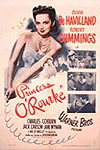
Tonight's Movie: Princess O'Rourke (1943)

A full decade before ROMAN HOLIDAY (1953) won the Academy Award for Best Writing, another tale of an incognito princess finding love won the Oscar for Best Original Screenplay. PRINCESS O'ROURKE (1943), written as well as directed by Norman Krasna, is not as well-remembered as ROMAN HOLIDAY, but it is a delightful movie which has been rather overlooked in the years since its release.

Olivia de Havilland, at her loveliest, plays European Princess Maria, forced into exile by WWII. Maria lives a secluded life in a New York City hotel, shadowed by the American Secret Service wherever she goes, and fussed over by her uncle (Charles Coburn) and secretary (Gladys Cooper, in a miniscule role). When Maria's planned solo airline trip to San Francisco goes awry, she meets Eddie, the pilot (Robert Cummings), and, as "Mary Williams," she enjoys a day on the town with him free of the usual royal protocol and restraints. They fall in love, of course, but duty calls for each of them -- Maria must return to her secret life as a princess and Eddie has recently enlisted in the Air Force. As one might expect, true love wins -- with a little help from FDR and his dog Fala.

Jack Carson gives one of his more low-key, appealing performances as Cummings' co-pilot and best friend. Carson and Jane Wyman, playing the girl Carson had married after a whirlwind courtship, have the best scene in the film. During a meal with Cummings and de Havilland in a Chinese restaurant, they explain in a half-joking, half-combative way how they'd met and quickly married; their verbal jousting is belied, however, by the moving way they hold each other when dancing. This one scene was to provide a major break in Wyman's career; she had spent many years in random second female lead roles, but Charles Brackett and Billy Wilder decided to cast her as the leading lady in THE LOST WEEKEND (1945) on the basis of her performance in PRINCESS O'ROURKE, in particular the restaurant scene.

Just a few years later Wyman would be vying with de Havilland for a Best Actress Oscar -- de Havilland's performance in TO EACH HIS OWN (1946) beat out Wyman in THE YEARLING (1946) that year, but within a couple more years Wyman took home her own award, for JOHNNY BELINDA (1948).

Charles Coburn is always entertaining; his best moment here comes as he rhapsodizes over the dynastic possibilities when he learns that Cummings comes from a family which has produced large numbers of boys. It's also a treat to see Harry Davenport turn up in the last sequence as the Supreme Court Justice, who is rousted from his bed in the middle of the night.

A side note of interest: Nan Wynn, who sings "Honorable Moon" in the Chinese restaurant scene, is best known to some as a singing double in various musicals, notably dubbing Rita Hayworth in MY GAL SAL (1942) and YOU WERE NEVER LOVELIER (1942). In the latter film she introduced the Jerome Kern standard "Dearly Beloved."

Writer-producer-director Norman Krasna specialized in writing "fairytale" romantic comedies, which also included BRIDE BY MISTAKE (1944), BACHELOR MOTHER (1939), and THE DEVIL AND MISS JONES (1941). He also wrote the screenplays for Hitchcock's MR. AND MRS. SMITH (1941), with Robert Montgomery and Carole Lombard, and for the beloved WHITE CHRISTMAS (1954). Krasna focused mainly on writing and producing; PRINCESS O'ROURKE was the first of his three directorial efforts.

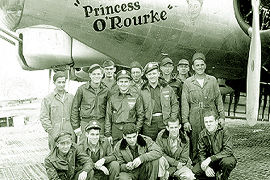
It's interesting to note that while the film may be unknown by many today, PRINCESS O'ROURKE was so highly regarded by some American soldiers during WWII that a plane was named for the film; de Havilland's picture was painted on the nose. The PRINCESS O'ROURKE was part of the 32nd Bomb Squadron. The plane's history can be read here.

The original New York Times review of PRINCESS O'ROURKE can be read here.

PRINCESS O'ROURKE runs 94 minutes and was filmed in black and white.

PRINCESS O'ROURKE is, unfortunately, not yet available on video or DVD. We can only hope that one day it will be part of a DVD set of de Havilland films -- hopefully including a featurette on the plane! In the meantime, it can be viewed occasionally on Turner Classic Movies. 

May 2009 Update: PRINCESS O'ROURKE is now available on DVD via the Warner Archive.

Newer›  ‹Older